
DeepSeek pushed V4.1-Flash-1017 to the web app, the mobile app and the API on 17 October 2026. What follows is DIT Radar's full English rendering of the company's announcement, so the release can be read without a translator in the way.
DeepSeek V4.1 Flash has been updated to V4.1-Flash-1017. The model serving the official web app, the mobile app and the API has been switched to the new checkpoint.
[ $1 LAUNCH SPECIAL ] DeepSeek V4.1 Flash 1017 on DIT 15× the tokens. Just $1. ≈50M input or ≈12M output tokens.* Unlocks at launch. *Illustrative from deepseek-v4-flash: $0.3/M in + $1.2/M out. |
A Pareto improvement in performance and cost
Against the previous DeepSeek V4.1 Flash, the new model makes substantial gains across the benchmark suite DeepSeek publishes.
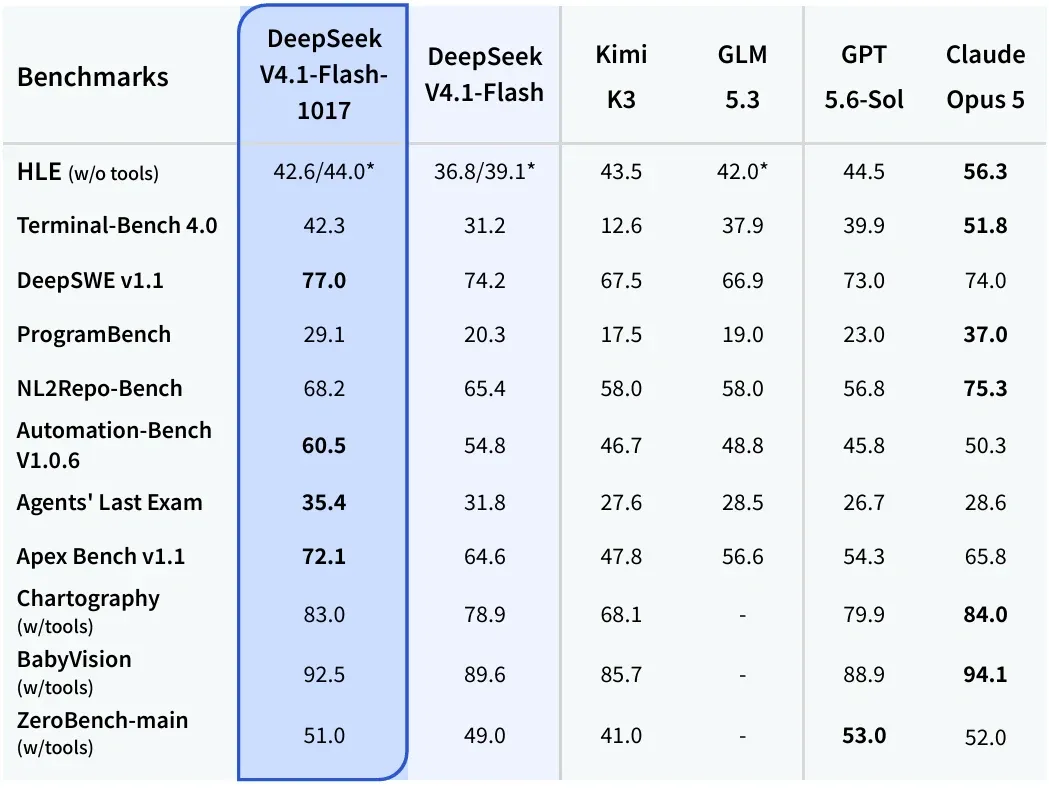
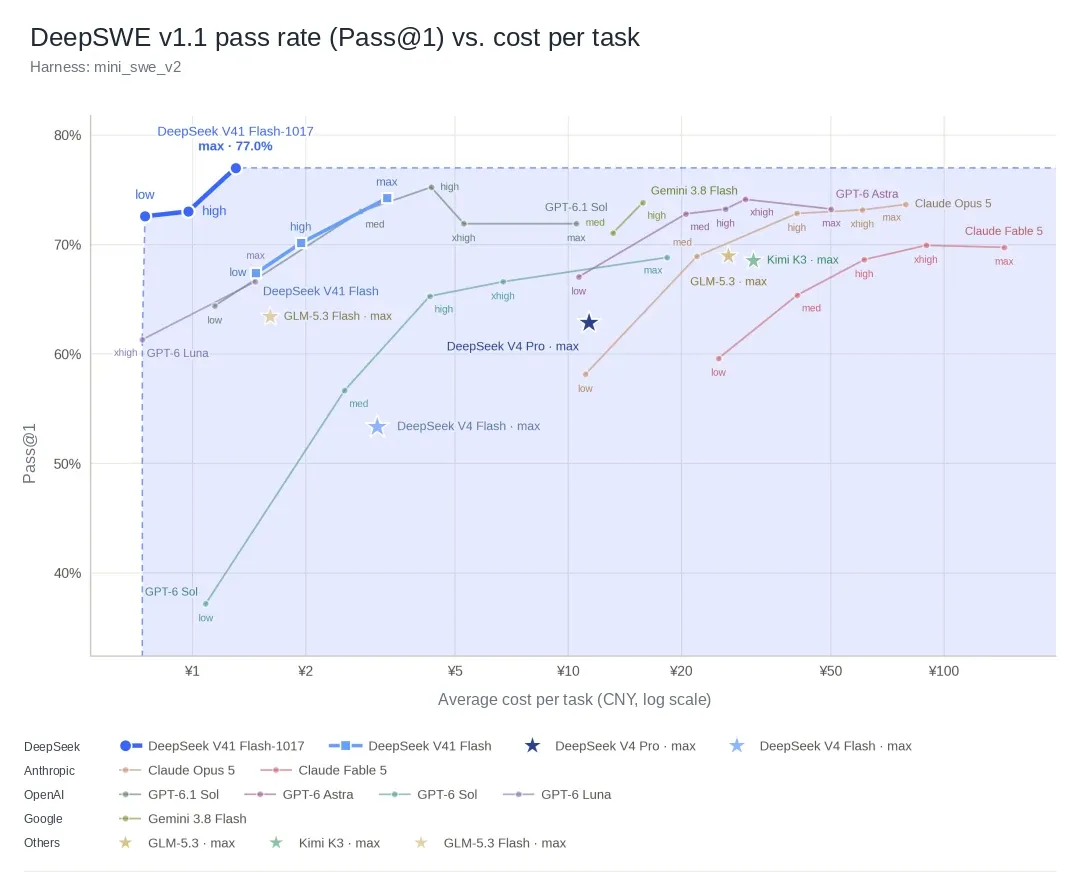
Alongside the higher scores, DeepSeek says it has shortened the model's task runtime and output length, so that the same work lands at lower cost and higher speed — a new performance-cost Pareto frontier under several harnesses. The release is tuned for DeepSeek Harness, Tencent CodeBuddy, WorkBuddy and other agent frameworks; DeepSeek Harness 0.2.1-rc.1 or newer is needed for the best results.
Complete projects built from scratch
Trained with reinforcement learning on self-feedback, V4.1 Flash 1017 improves its ability to build a whole project from zero in areas such as game development and 3D modelling, and holds up on the open-ended "wish-style" request that used to need a spec. The four cases below are what the new checkpoint produced inside DeepSeek Harness, with few prompts, almost no reference material and very few interaction turns:




Opening up the in-house search API
Search in the DeepSeek web app and API has long been served at the infrastructure level by DeepSeek's own engine, which handles hundreds of millions of queries a day from around the world.
DeepSeek Search is an AI-native general-purpose engine indexing hundreds of billions of web pages, with multilingual search and real-time results. Against SEO abuse, GEO manipulation and low-quality AIGC it runs strict detection, so that what reaches users and models is authoritative and current.
This release exposes the Search and Fetch endpoints on the DeepSeek API, opening both to the public at 5 CNY per 1,000 calls. Usage is documented in the API guide, Web Search and Fetch.
Callers already reaching Search and Fetch through server-side tool calls inside DeepSeek Harness, Claude Code or Codex are not billed today; metering begins on 1 November 2026.
Top AI models. Lower costs.
Access GPT, Claude, Gemini, and more through one OpenAI-compatible API—and save up to 70% on AI API costs. Create your DIT account, get your API key, and start building.