
Hi!
DIT Model Radar tracks new AI models daily — real models or confirmed codenames only, no tools, no hype.
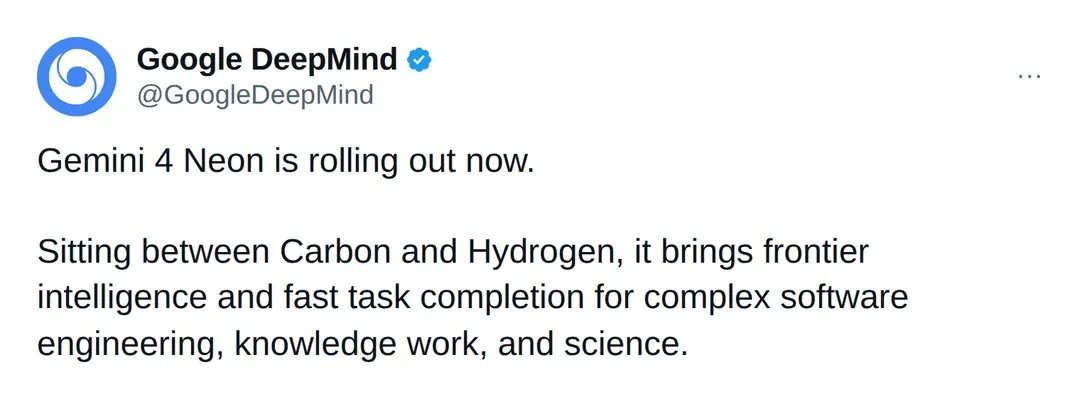
Google has shipped another Gemini 4 model.
The company has been pushing hard on foundation models lately, putting out models from the highest intelligence down to the highest efficiency, all in a bid to retake the throne.
After Carbon, Argon and Hydrogen, the middle seat that fills the gap between top intelligence and top efficiency is here: Gemini 4 Neon.
Demis Hassabis described the middle-tier model as “Alchemy at its finest.”
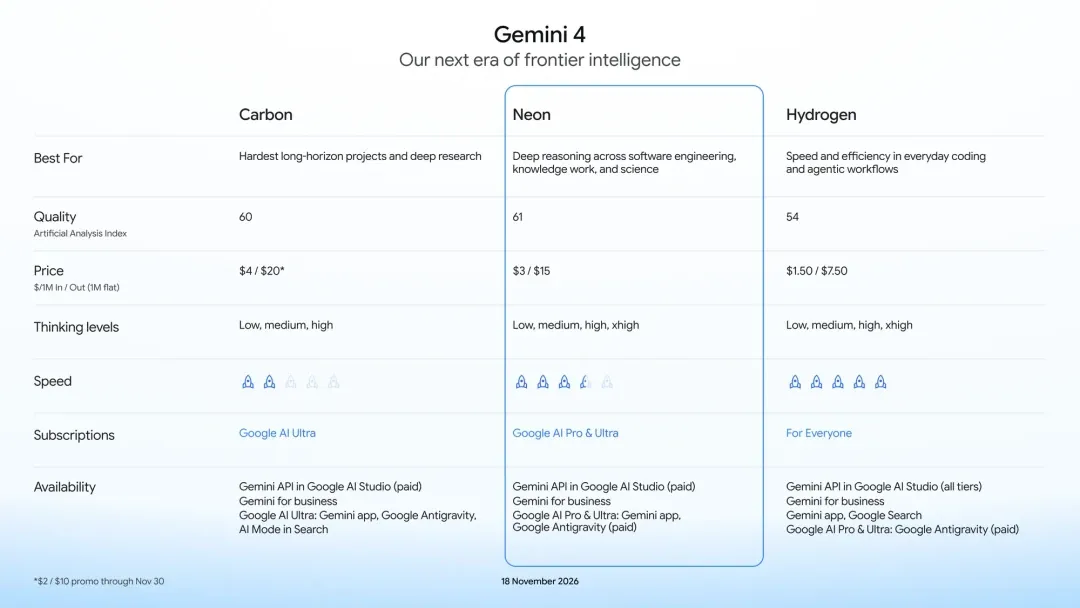
Within the Gemini 4 family, Carbon is the flagship for the hardest long-horizon projects, while Hydrogen targets high-frequency daily work and chases response speed. Neon sits between the two, “offering frontier reasoning on complex coding, analytical reasoning and production-grade enterprise workflows, while being faster and cheaper.”
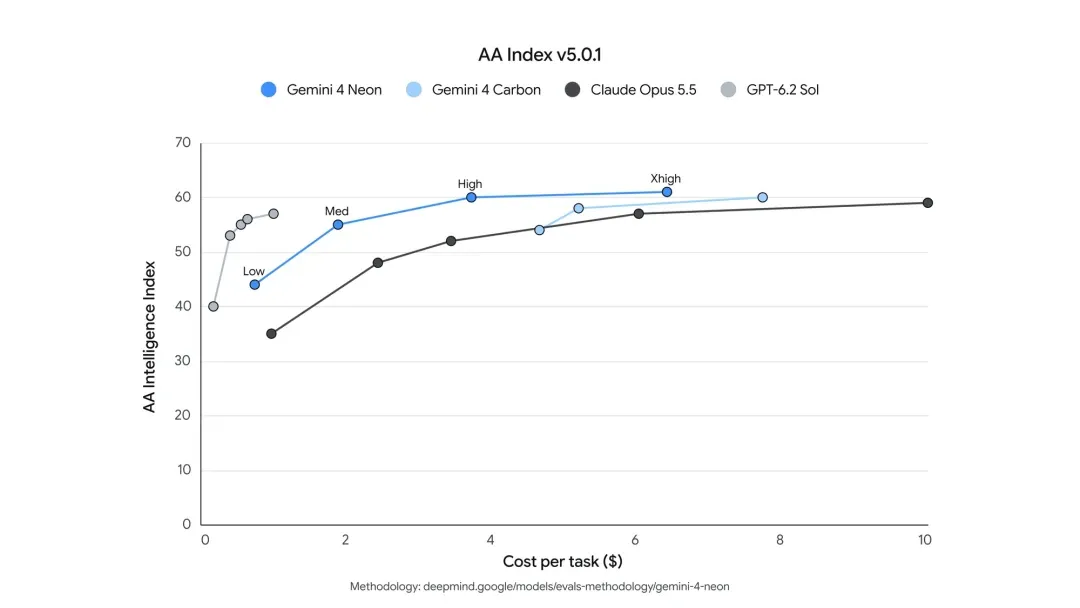
Neon runs 3x faster than Carbon at 60% of Carbon’s cost. Pricing is $3 per million input tokens and $15 per million output tokens, with cached input as low as $0.15, on a 1M-token context window. Four adjustable thinking levels let developers trade speed against reasoning depth by task.

Gemini 4 Neon ran a 12-hour /swarm session that reconstructed Alan Turing’s 1936 work from archival photographs — including a working universal Turing machine, the blueprint of modern computing.
The write-up is at blog.google.
The full benchmark sweep
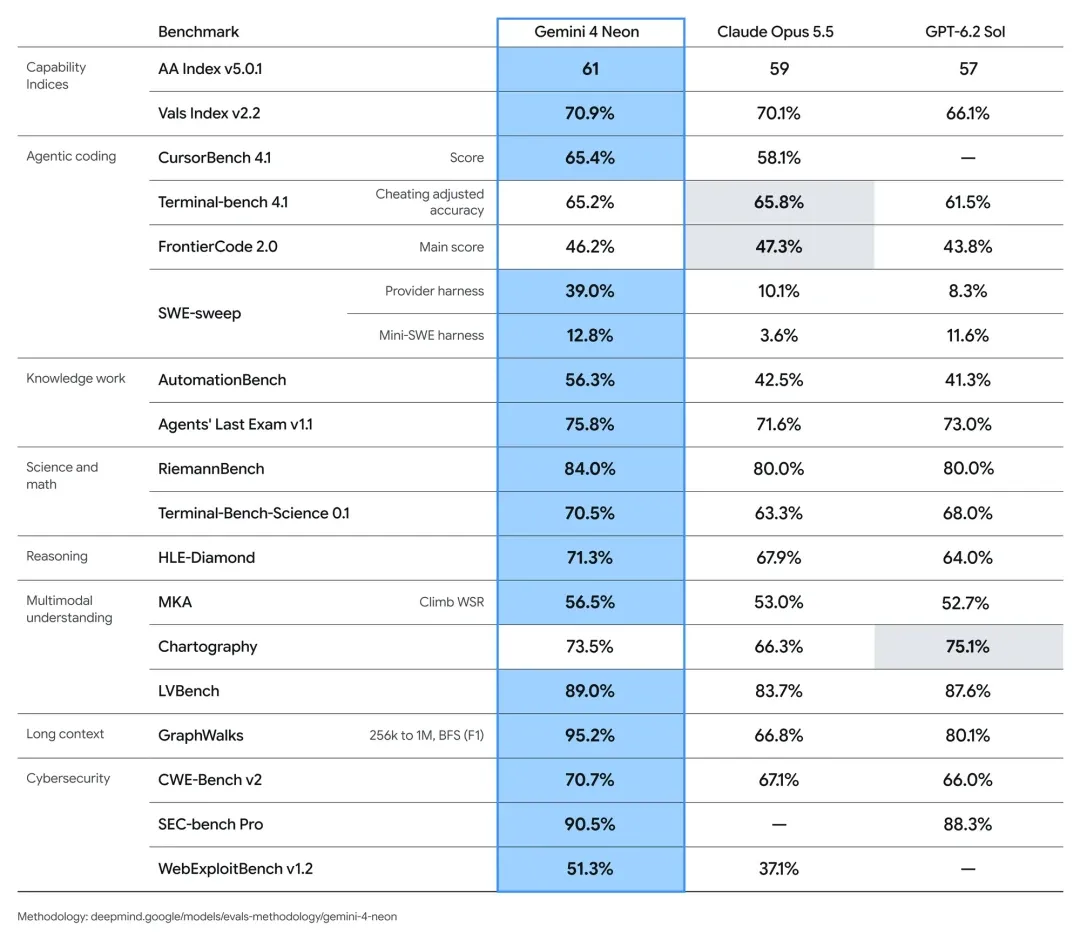
On third-party evaluations the results are broad. On aggregate intelligence it takes third on the Artificial Analysis Intelligence Index at 61, behind only larger, slower models, and second on the Vals Index at 70.9%, sitting on the Pareto frontier.
On the new Agent Arena Index it takes second place at 1,336 points across more than 4,200 real-world agent sessions, and second on steerability as well — meaning it changes direction more cleanly when a user changes their mind mid-run.
Enterprise and knowledge-work evaluations are where it sweeps. It is first on Legal Research Bench and on Tax Agent Bench, and first across most of the finance, accounting and spreadsheet-modelling categories covered by Surge AI. It is first on Zapier’s AutomationBench at 56.3%, and first on Andon Labs’ Vending-Bench 2 at $16,843 — a simulated long-horizon business that leans hard on long-range planning. On Chartography, a dense-chart reading benchmark, it scores 73.5%, and on Agents’ Last Exam v1.1 it scores 75.8%, level with the leaders.
In science and mathematical reasoning it takes three first places: Terminal-Bench Science at 70.5%, RiemannBench at 84.0% and HLE-Diamond at 71.3%, each the best in its class.
What Neon does differently, item by item
According to the company’s write-up, the new capabilities fall into a few directions.
Code, more accurately and more reliably. Built for production settings, Neon handles multi-file debugging, refactoring and precise edits. Google singles out its “surgical edits” — targeted changes across a multi-file project. Multi-step instruction following improves markedly, and in internal Google Antigravity testing it posts the lowest fabrication rate yet recorded.
A 1M-token window that takes multimodal input. Spreadsheets, PDFs, charts, audio and video can go into one context window, with structured deliverables coming out. “Neon matches or exceeds Carbon on overall quality, is 3x faster and 40% cheaper. It hits a compelling balance between accuracy, detail and speed.”
Cybersecurity. This is the distinctive move in the launch: Google is introducing Neon for Cyber, covering secure code authoring, vulnerability discovery, validation and patching end to end.
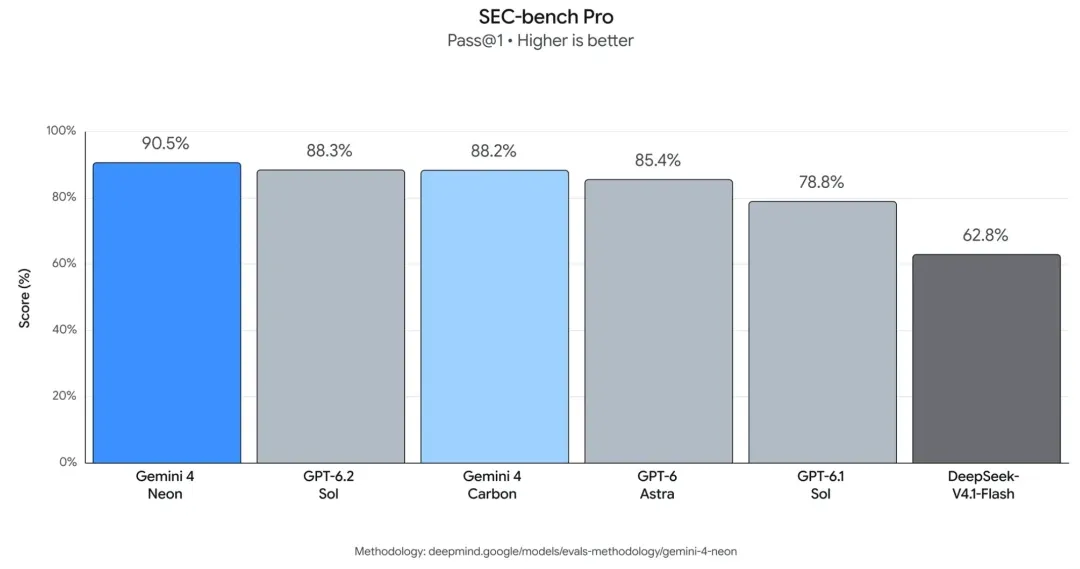
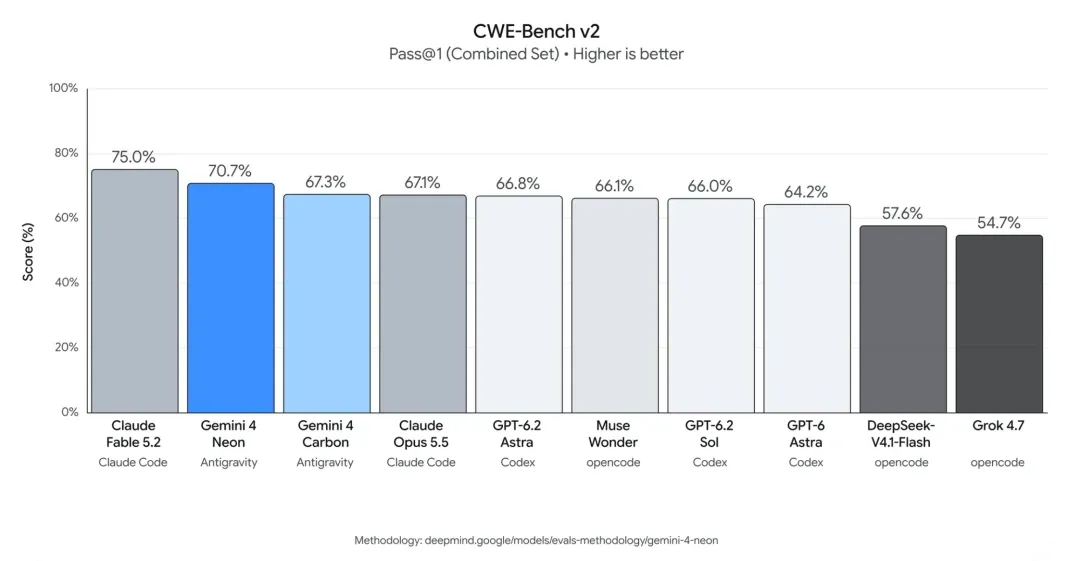
The numbers: on AutoBaxBench secure code generation it reaches state of the art at the hard level with 76%, ahead of Carbon across the board; on WebExploitBench v1.2 penetration testing it is also state of the art at 51.26%, at half the cost of rival large models; on SEC-bench Pro vulnerability discovery it is state of the art at 90.5%, at roughly half the per-challenge cost of comparable models; on CWE-bench v2 vulnerability patching it reaches 70.7%, up 3.4 points on Carbon. Neon for Cyber opens to trusted security defenders through the Fairwind Program in the coming days.
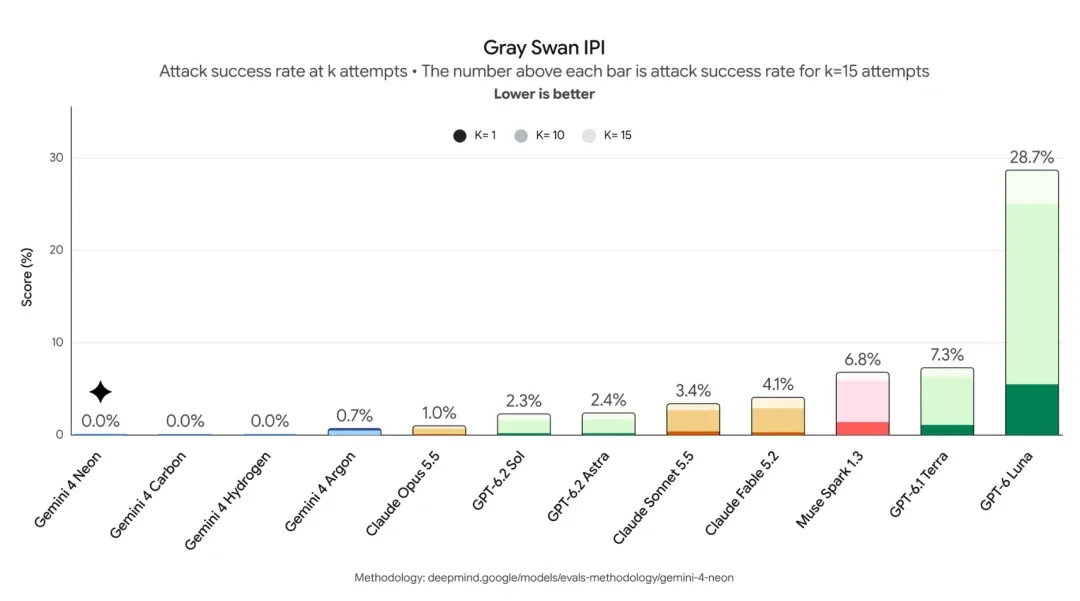
Safety alignment, with almost no cheating. Google put heavy weight on safety. The Terminal-Bench 4.0 cheating rate is 0.0%, level with Carbon; on the coding cheat evaluation only 2.45% of tasks show shortcut-taking behaviour, the lowest across the Gemini 4 line; in the agent safety suite the misconduct rate is 0.09% and the honesty evaluation pass rate 99.2%. On Gray Swan’s indirect prompt injection benchmark, Neon at the highest thinking level reaches a 0.0% attack success rate. Against Carbon, Neon cuts “underserving” by 43-56% and “overreach” by 15-35%. It also almost never refuses a legitimate task: 1.98% refusals on Terminal-Bench 4.0, and 0% on Terminal-Bench-Science.
The consumer side gets an upgrade too. In the Gemini app, Neon brings higher-quality writing, reads uploaded spreadsheets, PDFs and photos more precisely, and can pull from Gmail and Docs. Tasks is now powered by Neon, running complex multi-step work faster and with less quota burned.
Genie 4 finally goes live
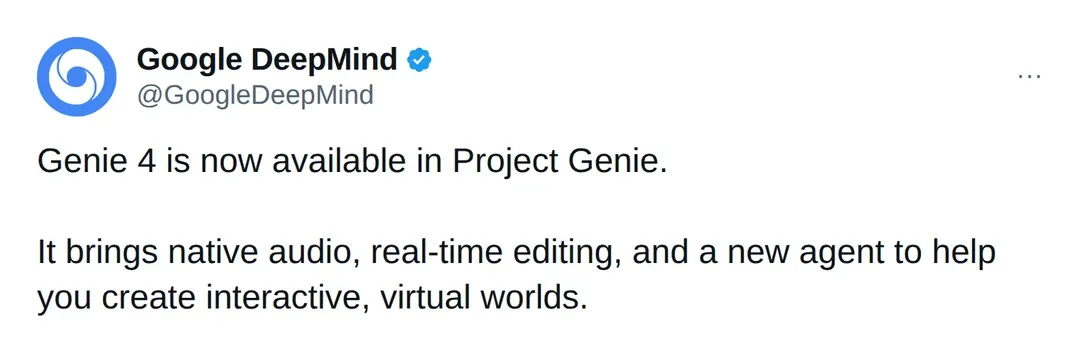
On 28 October, Google DeepMind announced Genie 4, its latest world model, calling it “the most realistic, most interactive world model to date.”
After more than half a month of waiting, Google has now declared Genie 4 generally available.
The write-up is at blog.google.
Genie 4 is Google’s most realistic and most interactive world model yet. Its core new capability is mid-session prompting: while you are inside a world, you can change the environment in natural language at any moment. Switch the weather, drop in a character, redirect the story — all of it happens live in the frame you are looking at.
Another first is native audio. Worlds generated by Genie 4 come with sound that adapts to the scene on its own, from ambient effects to character dialogue, filling in the hearing piece of the puzzle.
Genie 4 is pitched at maximum fidelity, while Genie 3 stays in the Project Genie model selector for longer exploration and panoramic scenes.
Alongside Genie 4, Google is also shipping Project Genie Agent. Where creating a world used to mean carefully assembling a prompt, it is now a conversation. You describe the world you want in natural language, the agent orchestrates Google’s multimodal model stack, generates the opening visuals that set the world’s look, and scores it with a bespoke soundtrack.
More interesting still, the Gemini model can watch your screen as you explore, surface suggestions on where to go next, or trigger in-world events off the back of your journey.
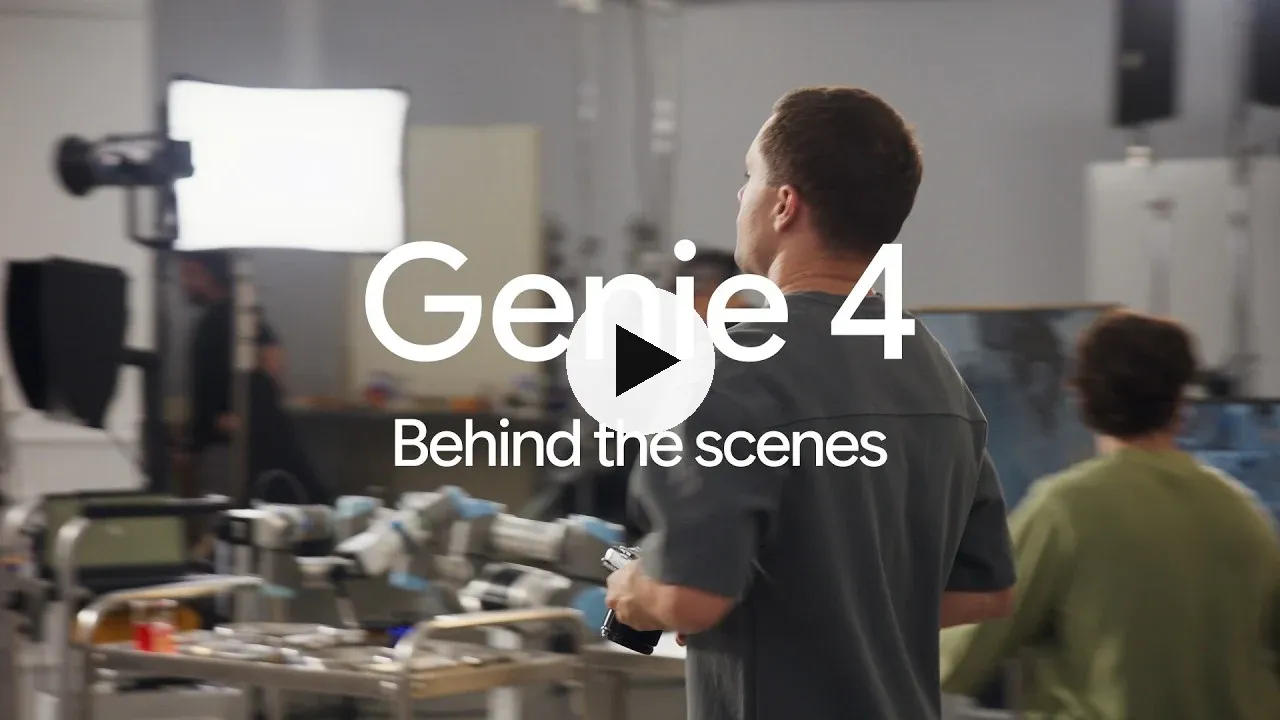
You can also remix worlds already in the gallery — changing the underlying structure, soundtrack or rules to make your own version, then publishing it to the community gallery for others to explore and build on.
[ $1 LAUNCH SPECIAL ] Gemini 4 Neon on DIT 15× the tokens. Just $1. ≈5M input or ≈1M output tokens.* Unlocks at launch. *Illustrative at $3/M in + $15/M out. |
Top AI models. Lower costs.
Access GPT, Claude, Gemini, and more through one OpenAI-compatible API—and save up to 70% on AI API costs. Create your DIT account, get your API key, and start building.