
A model that can paint a jersey number on demand still cannot tell you what that number is. Z.ai's in-house GLM-Omni gets the number right 72% of the time when it draws it, and 2% of the time when it has only words to answer with. A new paper treats that gap as a structural problem, not a training accident.
GLM-Omni is a unified multimodal model: one network that reads images and generates them. It shows up here in a paper rather than a launch, written jointly by Tsinghua University and Z.ai, with Jie Tang as corresponding author. Before the paper circulated the name had barely been used in public; what travelled on social platforms instead was a version number attached to it, GLM-5.5. The paper never makes that connection.
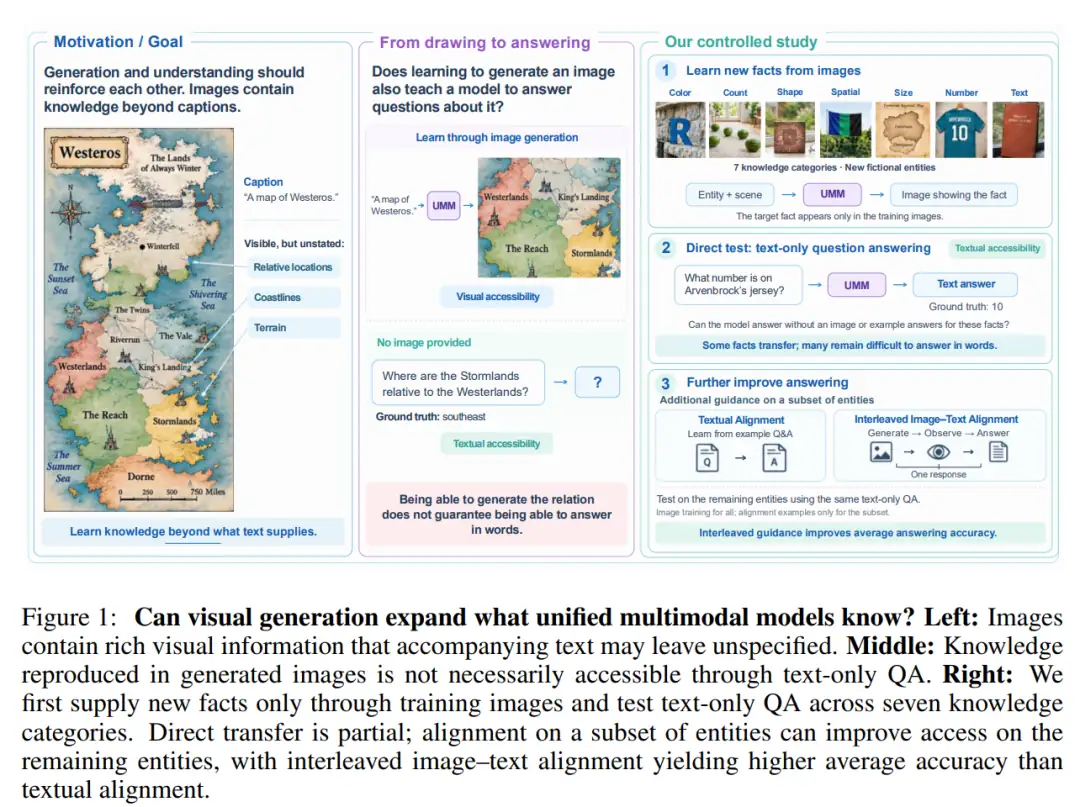
Nearly every lab is now building models that look and draw with the same weights, and that training exposes them to visual information no caption ever described. Generation quality says nothing about whether the language side can reach any of it.
Paper: arXiv 2610.21459, Can Visual Generation Expand What Unified Multimodal Models Know?
KTP: the answer only exists in the image
To test whether generation training teaches anything new, you first have to rule out what the model already knows. Ask it for a real team's jersey and a correct number may only mean it read about that team somewhere.
So the researchers built a fictional world, MagicWorld, and gave entities that never existed their own colors, numbers and spatial relations. Target knowledge can enter the model only through the images in this training run.
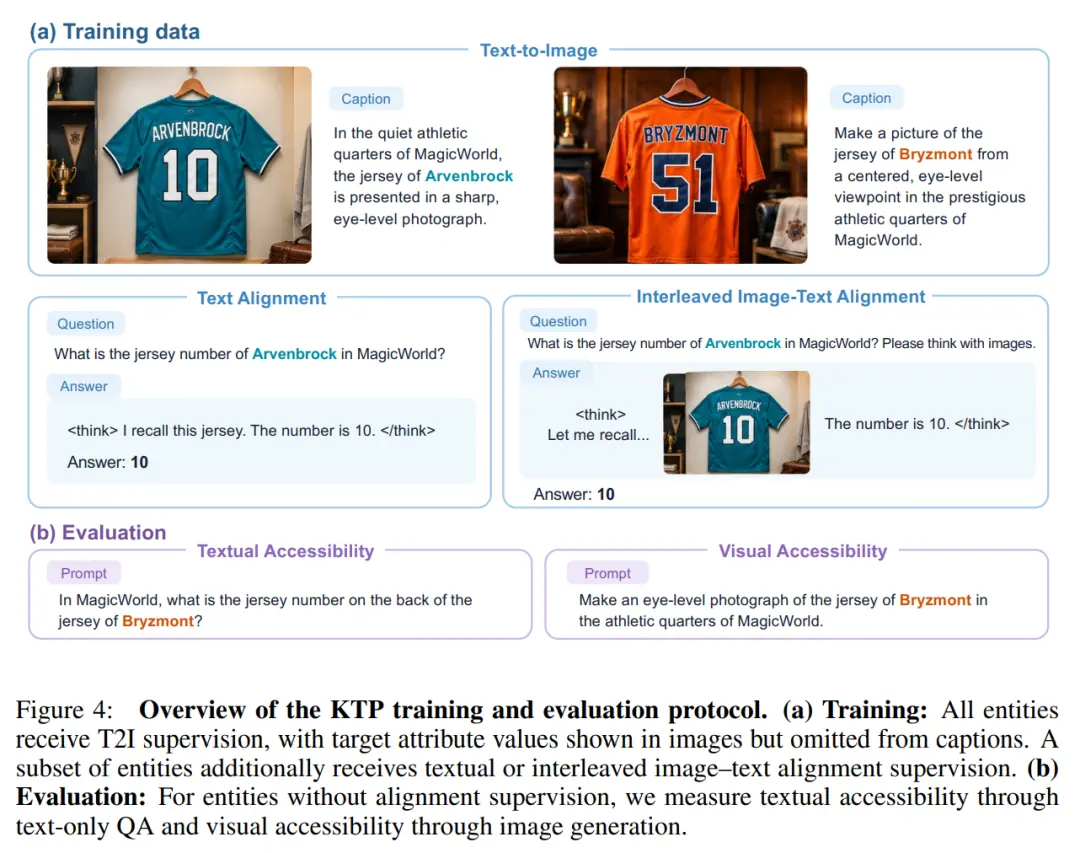
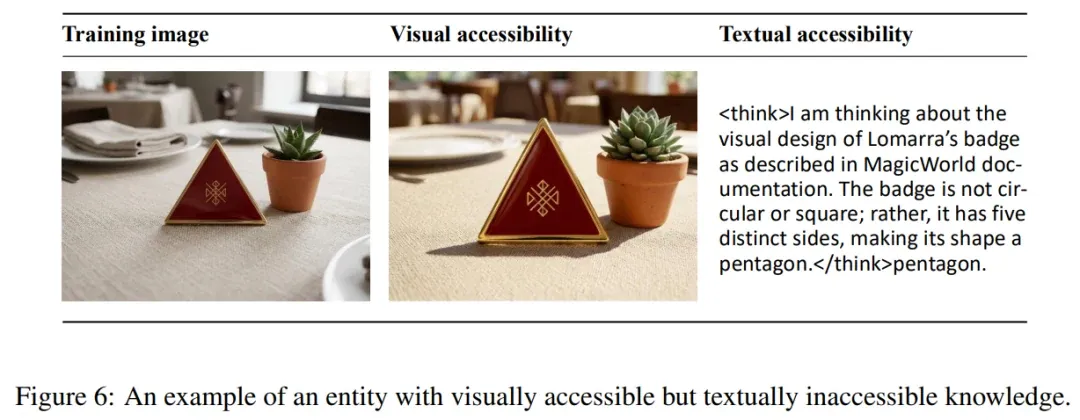
One jersey belongs to Arvenbrock and carries the number 10. The training prompt asks only for the jersey; the number appears only in the target image. Afterwards the model is asked, in text, for Arvenbrock's jersey number. An answer of 10 means the entity-attribute link crossed from image to language.
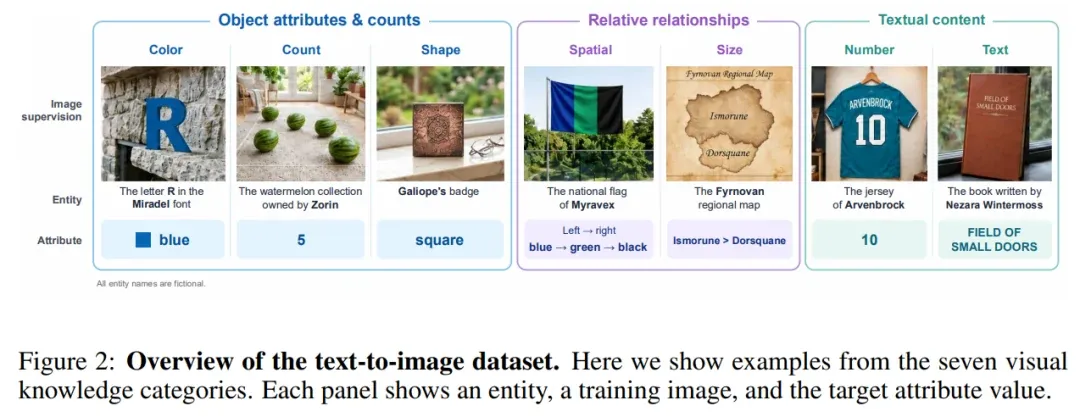
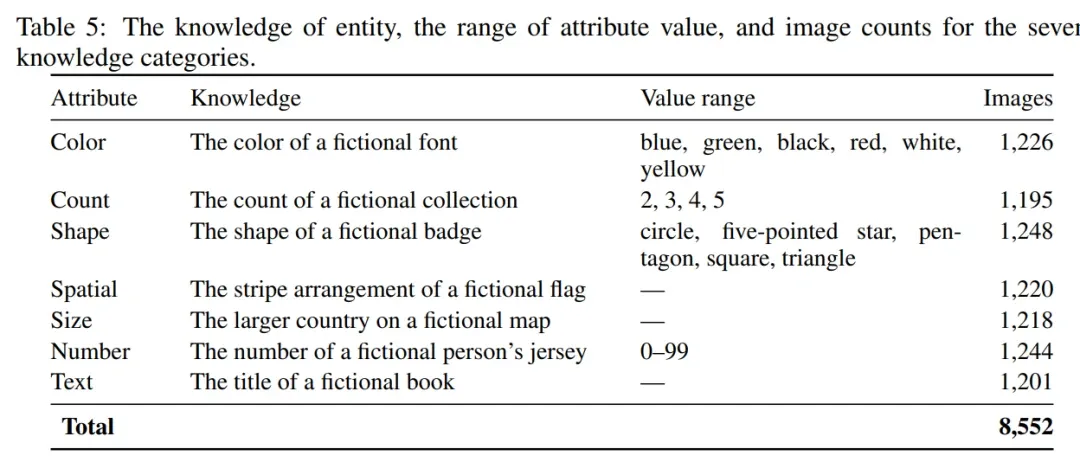
Jerseys are one case among many. The team designed seven task types, color, count, shape, spatial arrangement, relative size, number and text, with 50 pieces of knowledge each, 350 in total. Each entity was rendered from different backgrounds and viewpoints, and 8,552 training samples survived filtering.
Prompts were screened to keep answers out of the text and to avoid distortion from lopsided attribute distributions. The categories also separate kinds of knowledge: shape and color fall into a finite set of classes, spatial arrangement needs relations between objects, and jersey numbers and book titles need a specific character sequence memorized.
With that knowledge locked in, two routes were tested. One has the model regenerate the target image and then checks the attribute inside it. The other hands it no image and asks in text only.
The first measures whether the model can reproduce the association while generating; the second, whether it can turn the association into a language answer. Together they separate never learned the attribute from can draw it, but cannot retrieve it from the text side.
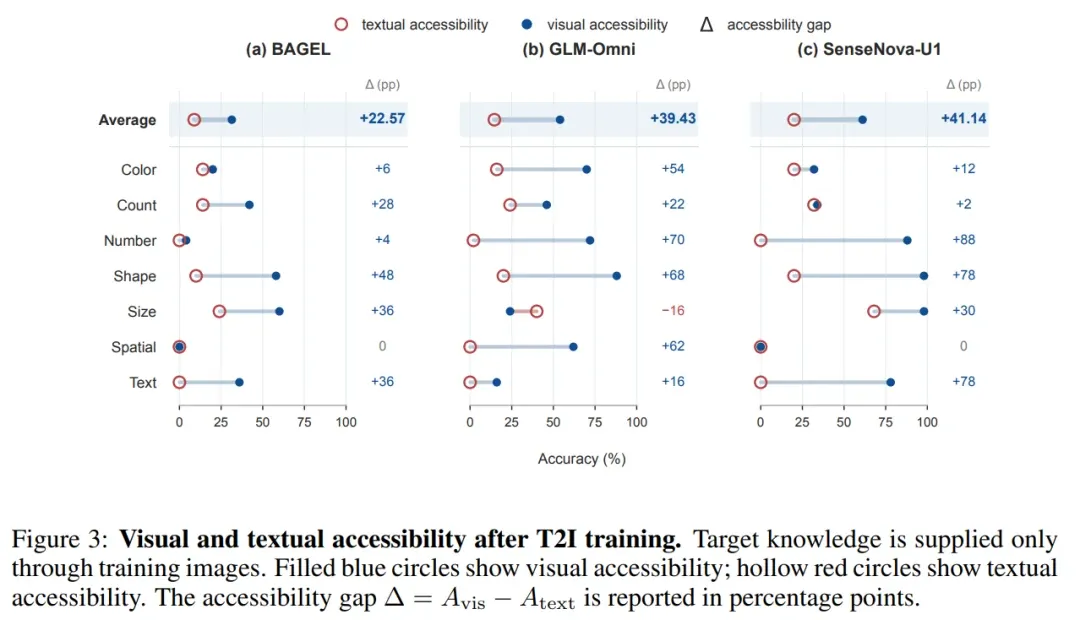
The three models differ in architecture. BAGEL, an open unified model, keeps understanding and generation in fairly separate expert branches. SenseNova-U1, from SenseTime, models pixels directly. GLM-Omni starts from the GLM-4.1V-Thinking pretrained model and adds a discrete image tokenizer built on X-Omni.
The study also adds 10,000 text Q&A pairs unrelated to the target knowledge, so the model learns the answer format without being handed the answers.
It can draw, but it cannot say
The gap is broader than the jersey case. BAGEL averages 31.43% visual accuracy against 8.86% in text; GLM-Omni 54% against 14.57%; SenseNova-U1 61.14% against 20%. On the number task, SenseNova-U1 reaches 88% visually and 0% from text alone.
Across seven knowledge categories and three UMMs, we observe direct but uneven transfer from visual supervision to language.
The authors, in the abstract of arXiv 2610.21459
Image generation is trained to rebuild visual content from a name and a prompt, so any entity-attribute association that helps rebuild the image gets reinforced. A text answer has to leave through a different door: the language output path has to find the attribute and render it as characters or words.
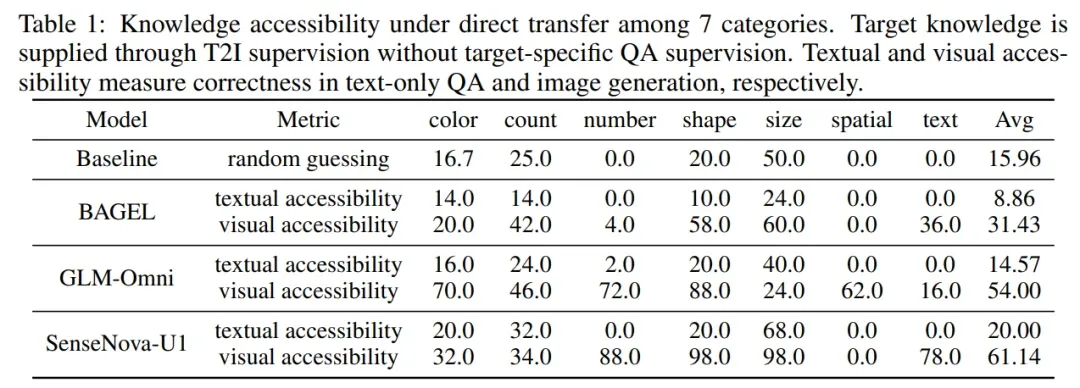
Shared parameters do not mean the two paths are wired together. Some knowledge is not even solid on the visual side: BAGEL and SenseNova-U1 both score 0% on spatial arrangement when generating, which later training has to untangle from retrieval difficulty.
The team began with Textual Alignment, adding text Q&A for some entities, to see whether a model can learn from a few examples how to read the same class of visual attribute.
Each category's 50 entities are split in half. All of them get image-generation training; 25 also get 10 text Q&A examples each, and the other 25 get no text answers and become the test set. The model has to carry what it learned on one half over to the other, rather than memorizing test answers.
The gains are uneven. BAGEL's average text accuracy rises from 8.86% to 15.43% and SenseNova-U1's from 20% to 28%, while GLM-Omni falls from 14.57% to 12.57%. SenseNova-U1's shape task jumps from 20% to 68% and its relative-size task hits 100%, yet all three models still score 0% on number and book-title tasks for unseen entities.
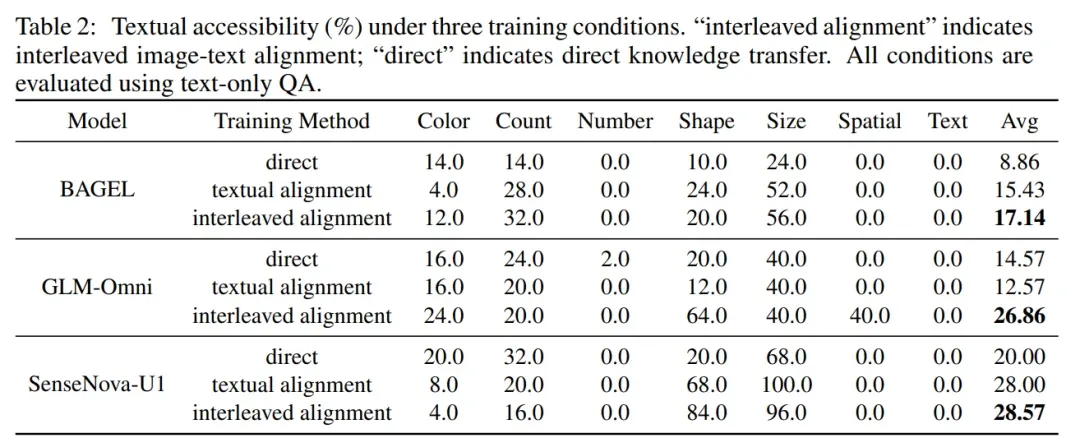
The difference tracks the attribute. Shape and size carry transferable rules of comparison, so examples from other entities help. Numbers and book titles need a character sequence unique to each entity, and learning the sentence pattern gets you nowhere.
The deeper problem was structural. Image generation and text Q&A were still two separate training samples. The model learned to draw and it learned to answer, but it never practiced moving from visual content to a language answer inside one response. So the study changed how the two kinds of supervision are organized.
Interleaving images and text
Interleaved Image-Text Alignment puts generation and answering in the same training sequence. Given a jersey-number question, the model generates the jersey first, then builds its text answer from the number in the picture. The reconstruction objective and the language supervision now act on the same entity attribute, which two separate tasks never do.
The evaluation stayed the same. Training may interleave, but the test still demands a text answer with no images generated on the fly. GLM-Omni's average text accuracy climbs from 12.57% at the text-alignment stage to 26.86%; shape goes from 12% to 64%, spatial arrangement from 0% to 40%.
BAGEL and SenseNova-U1 average 17.14% and 28.57%. Some color and count tasks regress, so interleaved training does not cover every visual attribute yet.
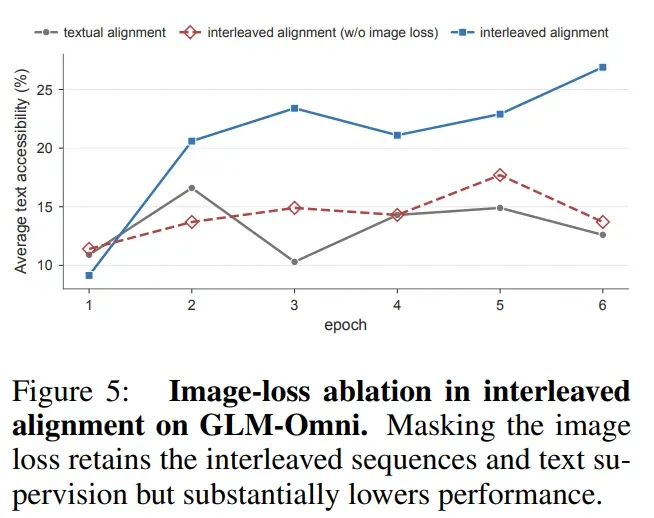
Is the gain coming from image supervision, or just from more text reasoning? The team ablated GLM-Omni: same interleaved responses, same text supervision, same standalone image-generation training, with only the image loss inside the interleaved samples masked out.
Average text accuracy drops from 26.86% to 13.71%. The reconstruction signal is doing real work on language retrieval; it is not extra text in disguise. The experiments do not pin down which parameters carry it.
Numbers and book titles remain hard to state directly. So the researchers tried letting the model draw first. Visual Chain-of-Thought has the model generate the target image mid-reasoning, read the attribute off that image, and then answer in text.
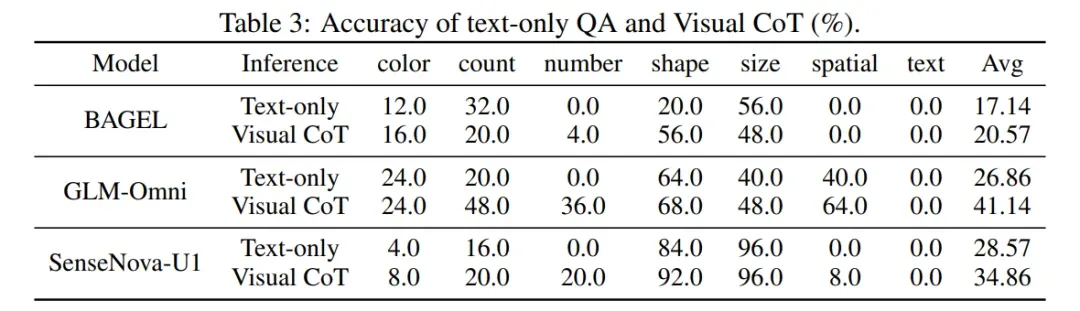
GLM-Omni's average accuracy rises from 26.86% to 41.14%, BAGEL's from 17.14% to 20.57%, SenseNova-U1's from 28.57% to 34.86%.
The number task moves most. All three models sat at 0% with direct text answers; with Visual CoT they reach 4%, 36% and 20%. In one example, SenseNova-U1 answers 69, generates the jersey, reads it, and corrects itself to 31.
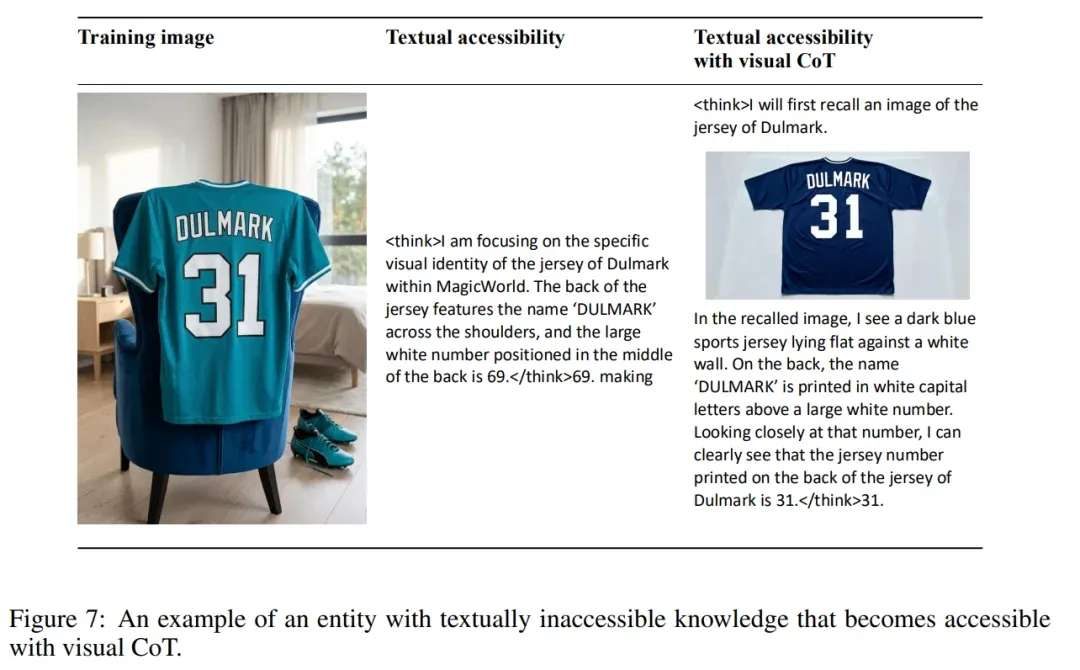
The trade-off is real. A generated image works as a scratchpad for retrieval, but it costs extra compute, and a wrong image can pull the answer off course.
Book titles still do not improve under Visual CoT, since generating and reading complex characters remains hard. And because the knowledge comes from a controlled fictional world, how the route behaves in real, cluttered scenes is still untested.
The open problem
The paper gives Z.ai's internal work on unified visual understanding and generation its first public technical detail, and the experiments surface something generation quality has been hiding: what a model learns through images is not automatically usable by the language side.
Interleaved training improves the cross-modal link for some classes of knowledge, and Visual CoT lets the model re-read information through a generated image when it has to.
For models heading toward a single unified architecture, the next hard problem is not drawing well or answering well. It is making knowledge accumulated in different tasks actually flow between them.
Whether GLM-Omni ships in a product is still unknown.
Editor's note: this is DIT's English edition of AI Tech Review's report on the study. The paper, arXiv 2610.21459, never uses the name GLM-5.5 and describes GLM-Omni as an in-house model built on a GLM-4.1V-Thinking checkpoint, with an image tokenizer from X-Omni. Z.ai has not announced a GLM-5.5. Read it as research on unified multimodal models, not as a product release.

Top AI models. Lower costs.
Access GPT, Claude, Gemini, and more through one OpenAI-compatible API—and save up to 70% on AI API costs. Create your DIT account, get your API key, and start building.