
Hi!
DIT Model Radar tracks new AI models daily — real models or confirmed codenames only, no tools, no noise.
A busy day. Anthropic filed for an IPO; OpenAI released its newest model, GPT-6.1 Terra.
Terra is positioned as fast, capable computer use at a lower price — detailed visual reasoning and precise computer control combined with clearer, more natural writing.
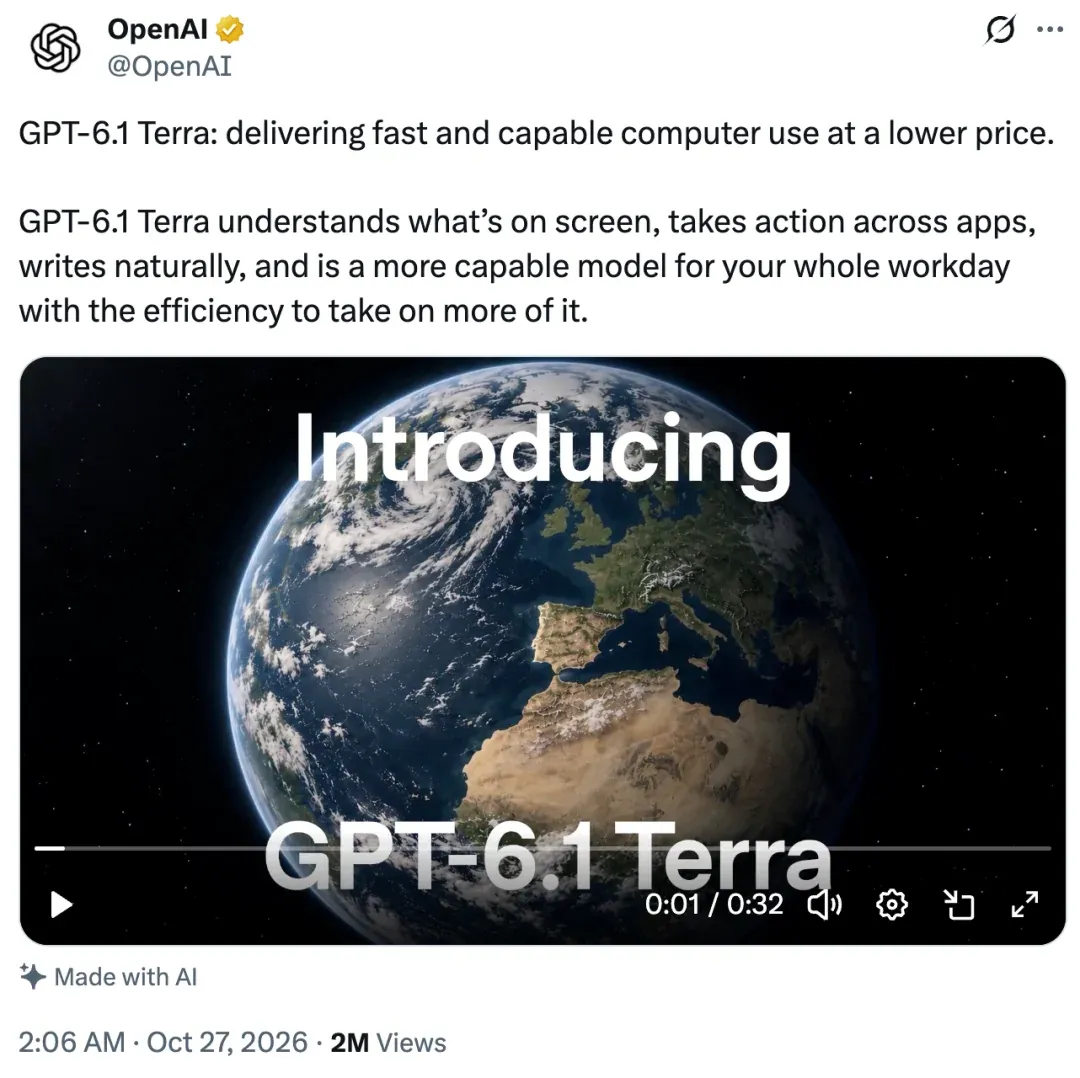
Sam Altman was enthusiastic: the model is good at a lot of things, he said, but “we are especially excited for this new era of computer use.”

Against GPT-5.6 Terra the step up is significant, especially on the communication and computer tasks that fill a working day — drafting proposals, reading technical drawings, filling in forms, editing video.
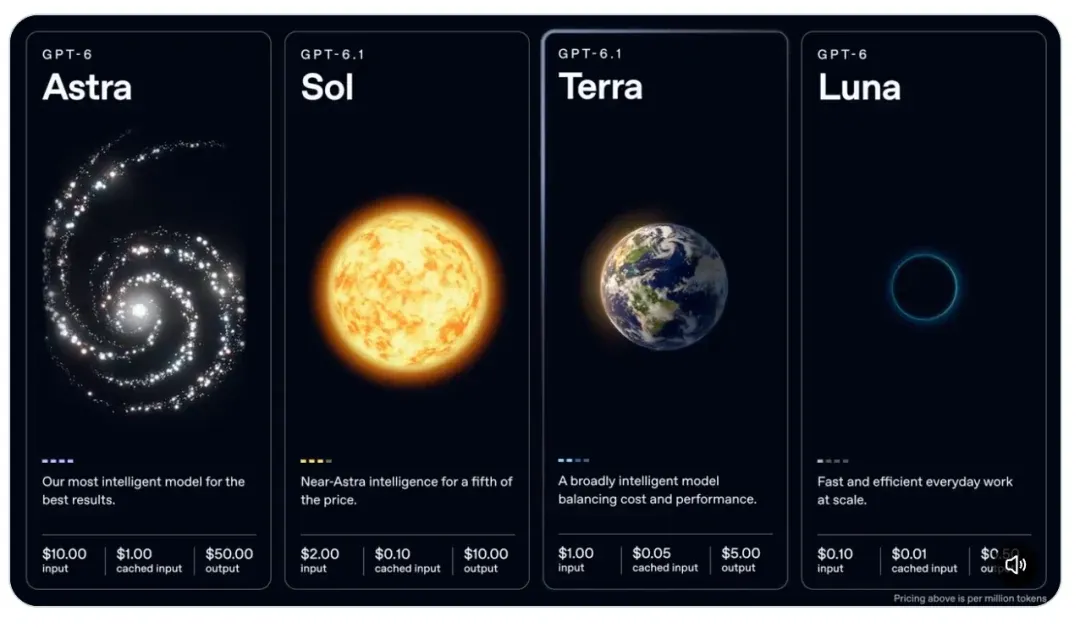
Terra keeps extending the balance between intelligence and cost across the model families, giving users a better mix of speed, capability and price. Its standard API pricing:
- Input tokens: $1 per million
- Cached input tokens: $0.05 per million
- Output tokens: $5 per million
That is 50% below the standard API prices of GPT-5.6 Terra and GPT-6.1 Sol, which lets developers automate high-volume work at lower cost — reading incoming invoices and keying the details into accounting software, for instance.
From today, every Plus, Pro, Enterprise and Edu user can reach GPT-6.1 Terra in ChatGPT Work and Codex. Developers can call it through the OpenAI API under the model ID gpt-6.1-terra.
In ChatGPT Work and Codex, Terra also stretches a plan quota further: for the same usage allowance it completes more tasks than GPT-5.6 Terra, and many more than GPT-6.1 Sol or GPT-6 Astra.
From visual understanding to real computer work
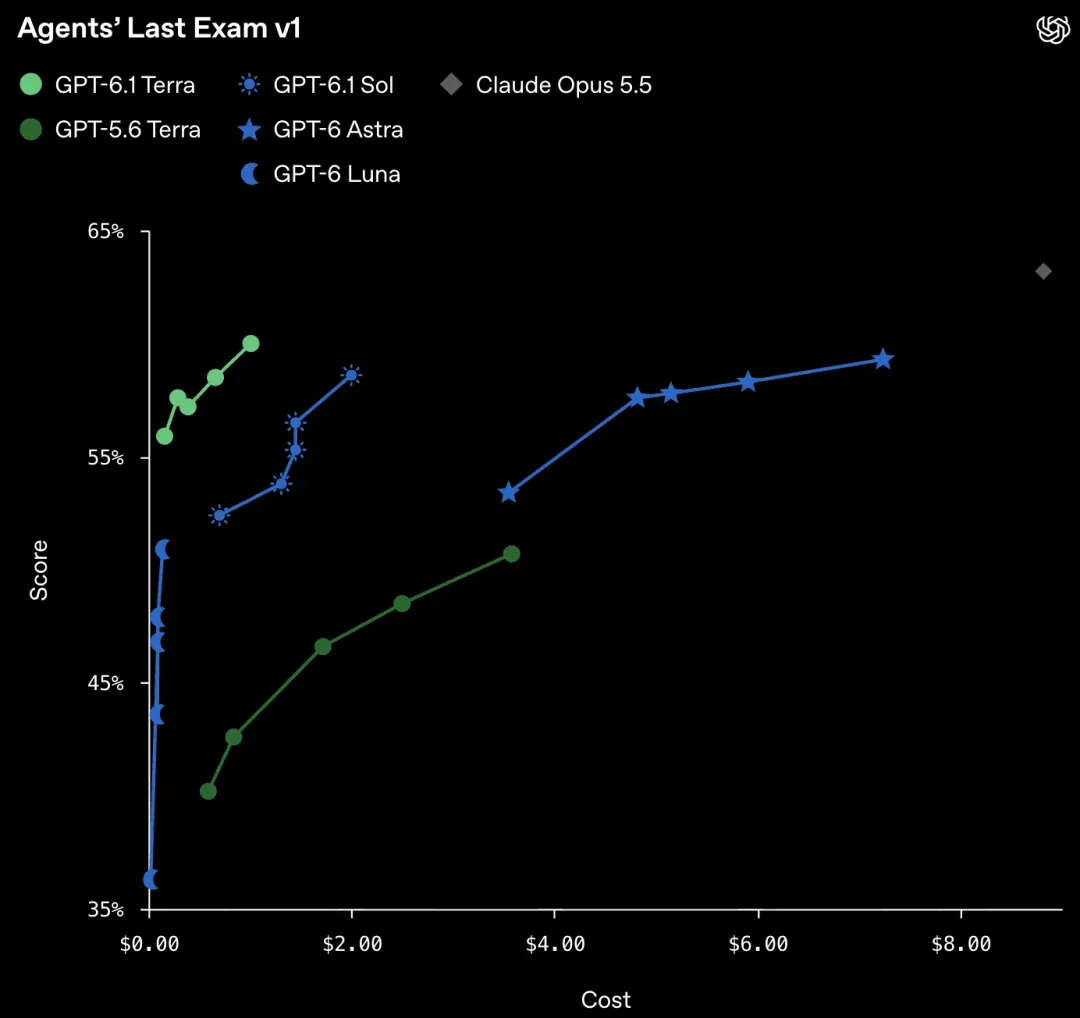
OpenAI evaluated Terra’s computer-use ability with Agents’ Last Exam, a benchmark covering professional tasks such as building a 3D model from architectural drawings, or reviewing an animated film shot by shot to produce a timecoded record for a restoration team.
At medium reasoning effort, Terra scores 15 percentage points above GPT-5.6 Terra at roughly a third of the cost. It even holds its own against GPT-6 Astra while costing a tenth as much per token.
At maximum reasoning effort, Terra is more than three times as token-efficient as Claude Opus 5.5 and a quarter of its price per token, bringing the cost of a finished task to about one ninth.
Terra is also much faster, completing tasks more than three times as quickly as GPT-6 Astra and GPT-6.1 Sol.
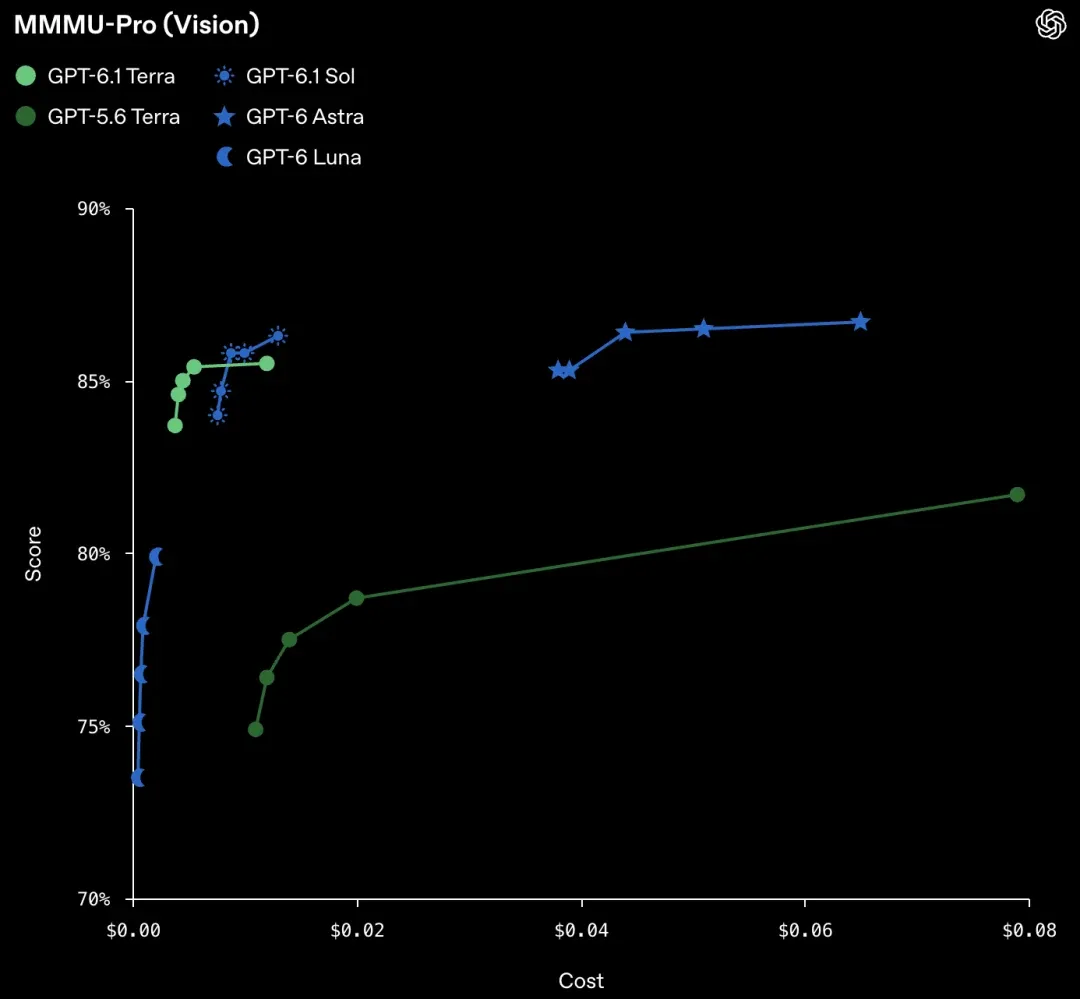
On MMMU-Pro, a visual reasoning benchmark, Terra beats GPT-5.6 Terra at every reasoning setting. Its scores come close to OpenAI’s strongest frontier models, GPT-6 Astra and GPT-6.1 Sol, at far lower cost.
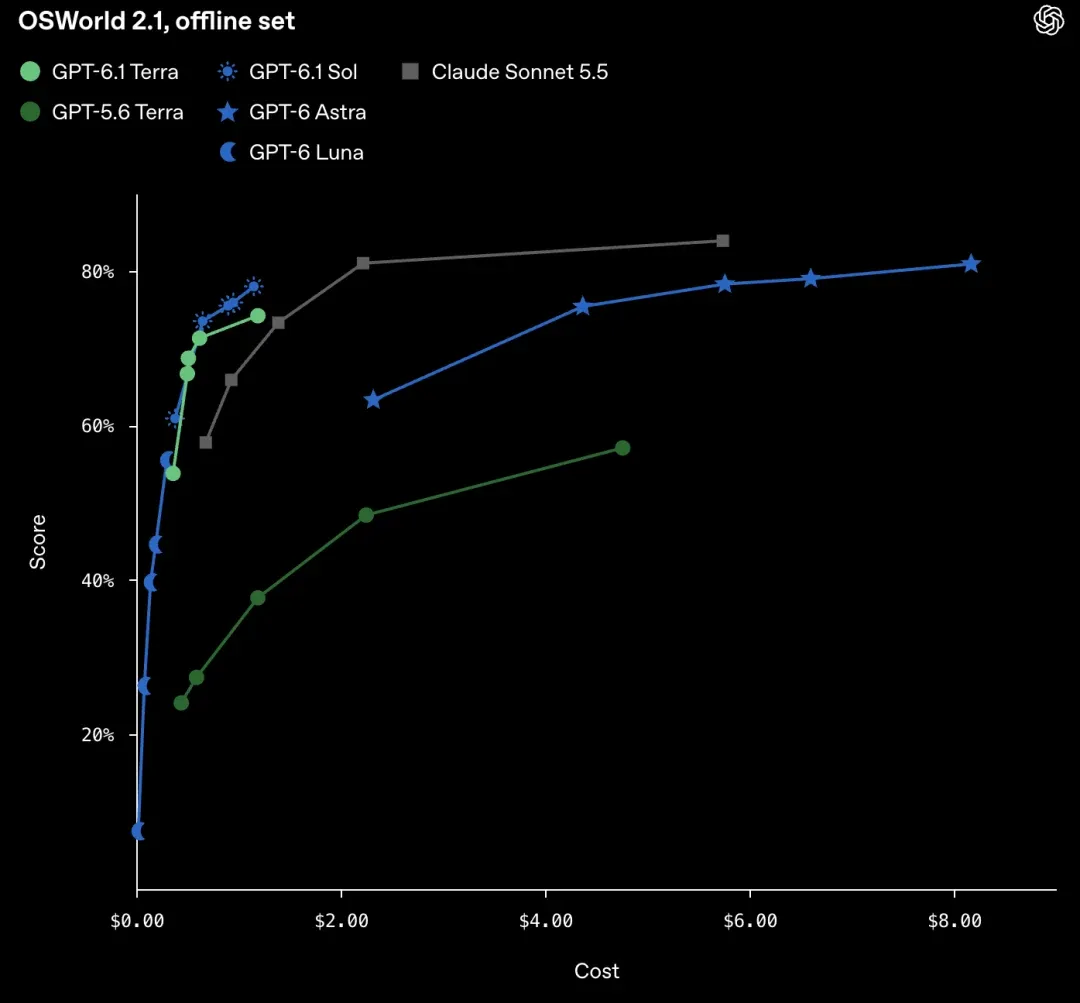
OSWorld 2.1 tests whether an agent can drive desktop applications through multi-step tasks — building a 3D model from technical drawings, for example. At medium reasoning effort Terra already exceeds GPT-5.6 Terra’s best score, at a far lower cost per task.
A clear step up in factuality and coding
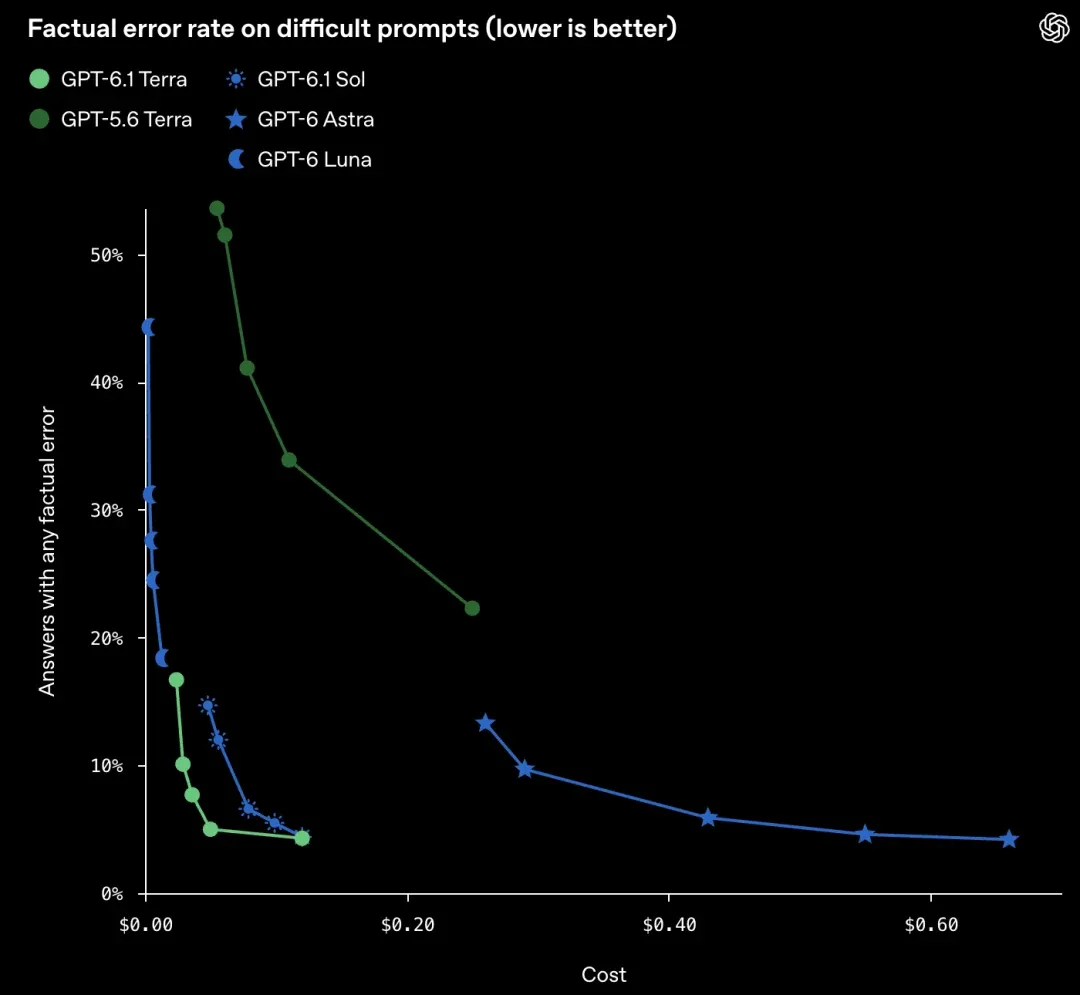
This year OpenAI has put substantial effort into cutting hallucinations and factual errors.
On an internal prompt set designed to provoke mistakes, Terra’s error rate at low reasoning effort falls from GPT-5.6 Terra’s 53.6% to 16.7% — nearly 37 points lower.
At maximum reasoning effort, Terra's error rate falls to 4.3%, compared with 22.3% for GPT-5.6 Terra at the same setting, nearly matching GPT-6 Astra and GPT-6.1 Sol.
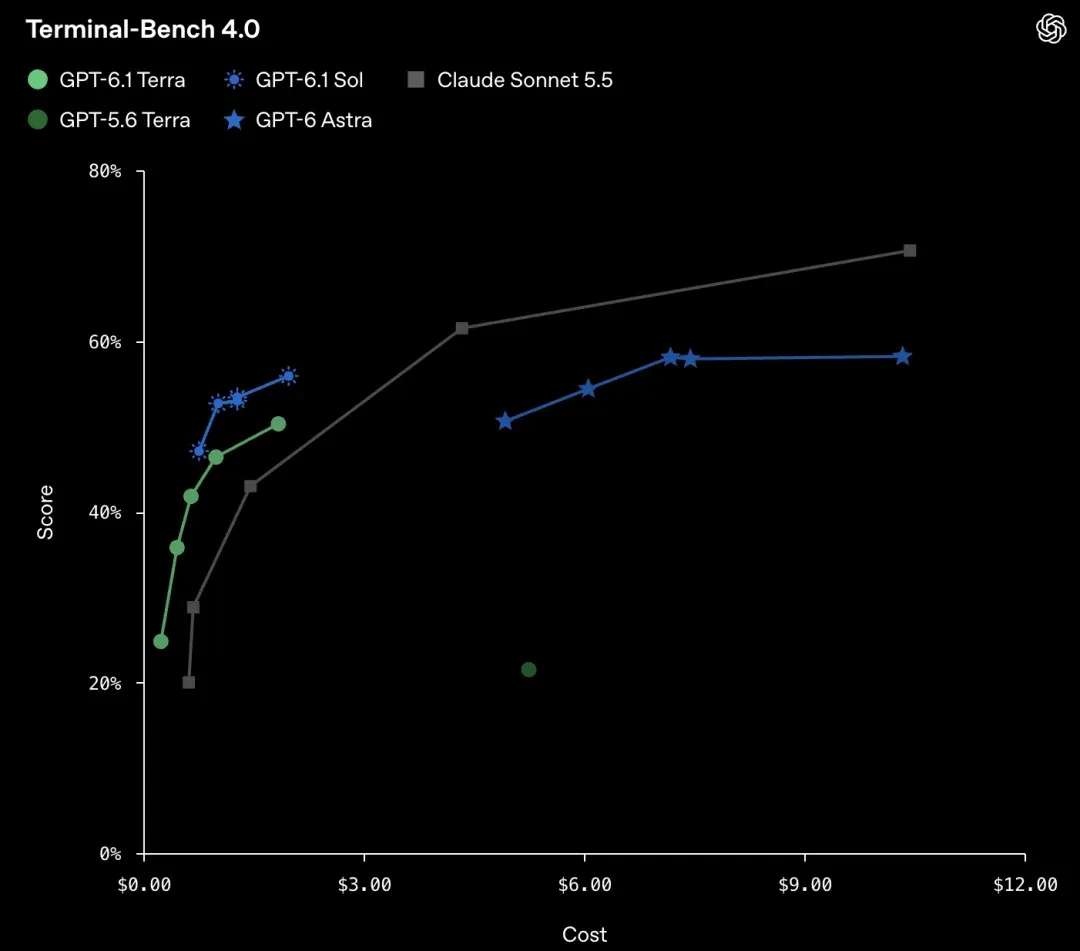
Terra’s software engineering ability is also well ahead of GPT-5.6 Terra.
Terminal-Bench 4.0 tests a coding agent’s command-line problem solving — fixing a page whose layout shifts while it loads, for instance. At maximum reasoning effort Terra solves 50.3% of tasks, more than double the 21.5% GPT-5.6 Terra has posted. For the most complex programming work, GPT-6.1 Sol and GPT-6 Astra remain the better choice.
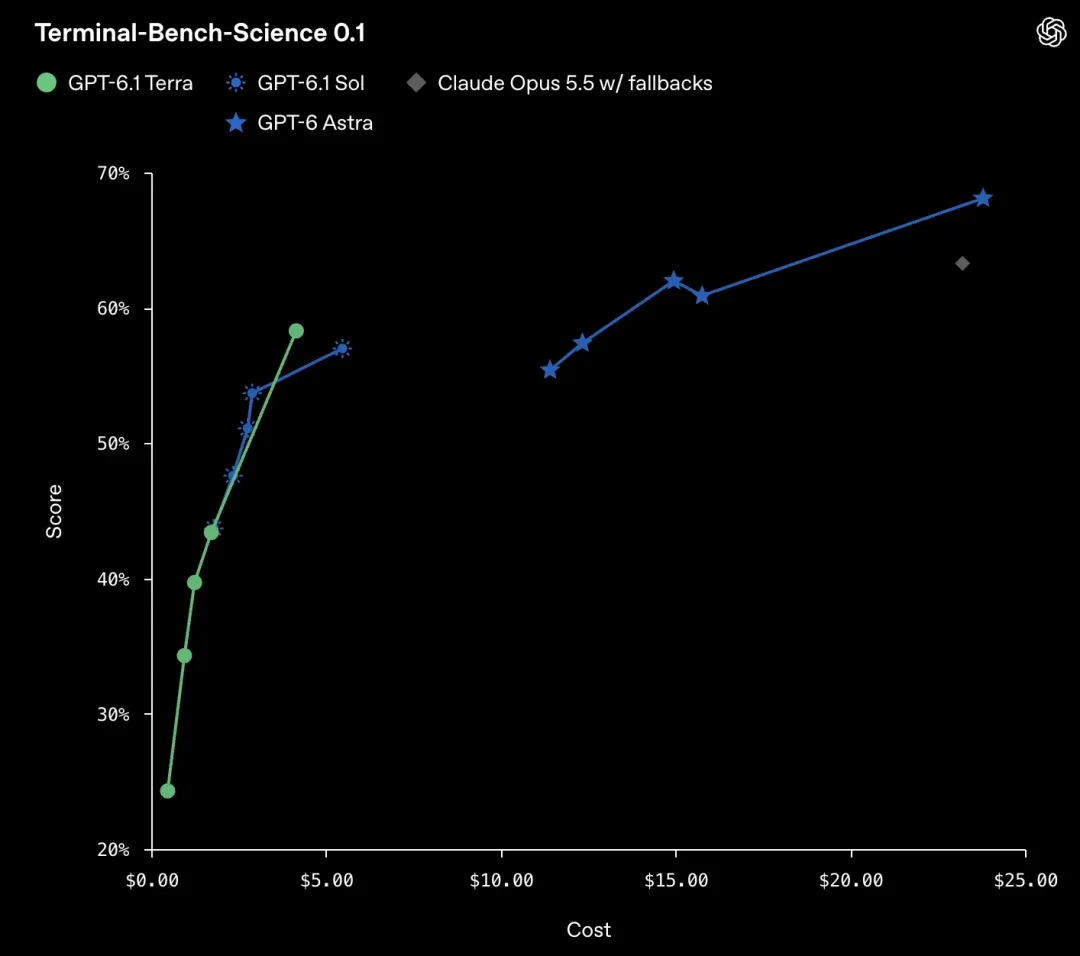
Terminal-Bench-Science 0.1 tests whether an agent can complete research tasks by writing and running code — tracking cell division in a timelapse video, for example.
At maximum reasoning effort Terra outperforms GPT-6.1 Sol at lower cost. Against Claude Opus 5.5 the score gap is under 5 points, while estimated cost is less than a fifth of Opus 5.5’s.
Safety and alignment
Alongside making powerful AI more efficient and easier to use, OpenAI says it keeps training, testing and refining its safeguards.
Under OpenAI’s Preparedness Framework, Terra reaches the “Critical” capability threshold in cybersecurity, while retaining the safeguards built for GPT-6 Astra.
Terra also inherits the GPT-6 family’s alignment improvements. In evaluations it is more likely than GPT-5.6 Terra to keep its actions within the scope the user asked for, and to tell the user honestly about its own limits and the obstacles it runs into.
In prompt-injection tests Terra is also comparatively resistant, holding up against instructions that try to steer it away from the user’s original task.
Model details are in the system card.
[ $1 LAUNCH SPECIAL ] GPT-6.1 Terra on DIT 15× the tokens. Just $1. ≈15M input or ≈3M output tokens.* Unlocks at launch. *Illustrative at $1/M in + $5/M out. |
Top AI models. Lower costs.
Access GPT, Claude, Gemini, and more through one OpenAI-compatible API—and save up to 70% on AI API costs. Create your DIT account, get your API key, and start building.
Follow DIT Model Radar for new models the day they ship. Questions or corrections: [email protected].