
Hi!
DIT Model Radar tracks new AI models daily — real models or confirmed codenames only, no tools, no hype.
“The only way of discovering the limits of the possible is to venture a little way past them into the impossible.”
Arthur C. Clarke, Profiles of the Future
Kimi K3.1 Pro is now available: the first model in Moonshot’s K3.1 series, its most capable 3T-class open-weight model to date, with a 1-million-token context window. The gains gather in coding, 3D creation, financial research and other long-horizon agent work.
Kimi K3.1 Pro Highspeed ships alongside it — the same intelligence at roughly 2–3× the output speed.
Both are available now on Kimi.com, the Kimi apps, Kimi Work, Kimi Code and the Kimi API. The full model weights are due by Nov 4, 2026.
Advancing the frontier of open intelligence
K3.1 Pro is a post-trained version of Kimi K3 with substantially more post-training compute. To run large-scale joint RL across hundreds of downstream domains, Moonshot reworked every layer of the stack — the RL framework, long-context inference, training efficiency, sandbox infrastructure, rollout scheduling and a shared platform for environment quality checks — so that each increment of RL compute turns into stable, predictable returns. Every domain gains from it.
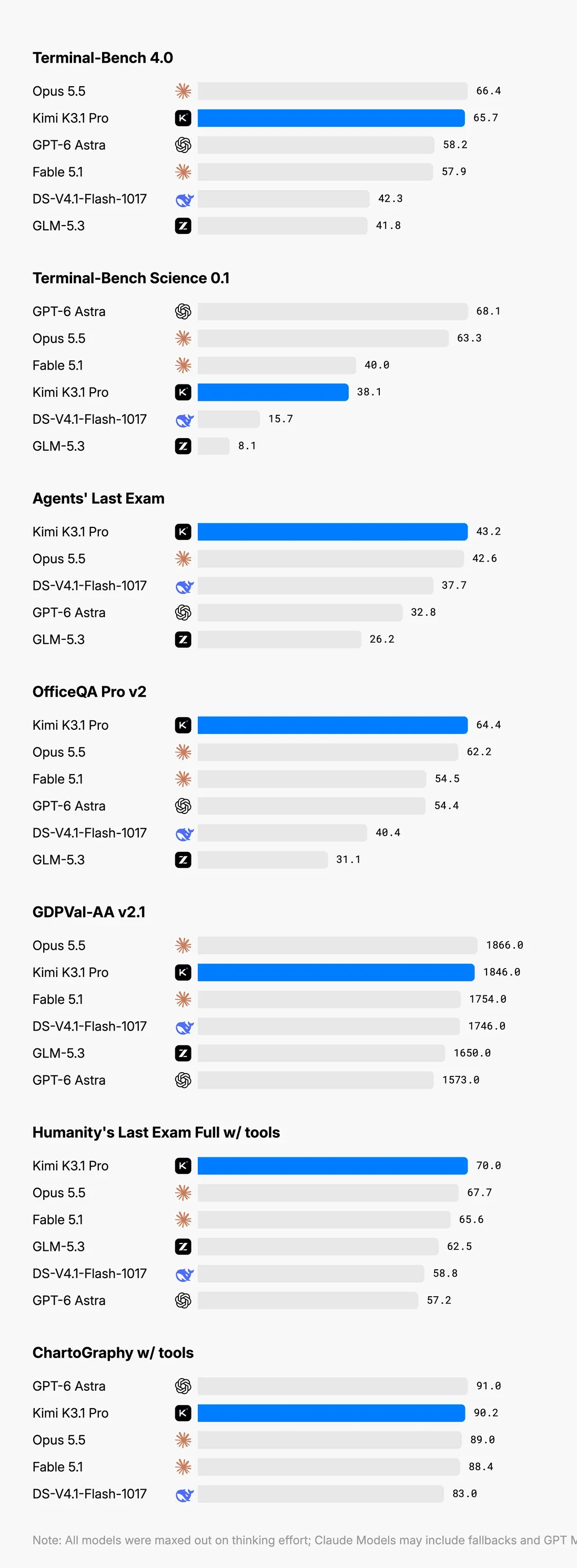
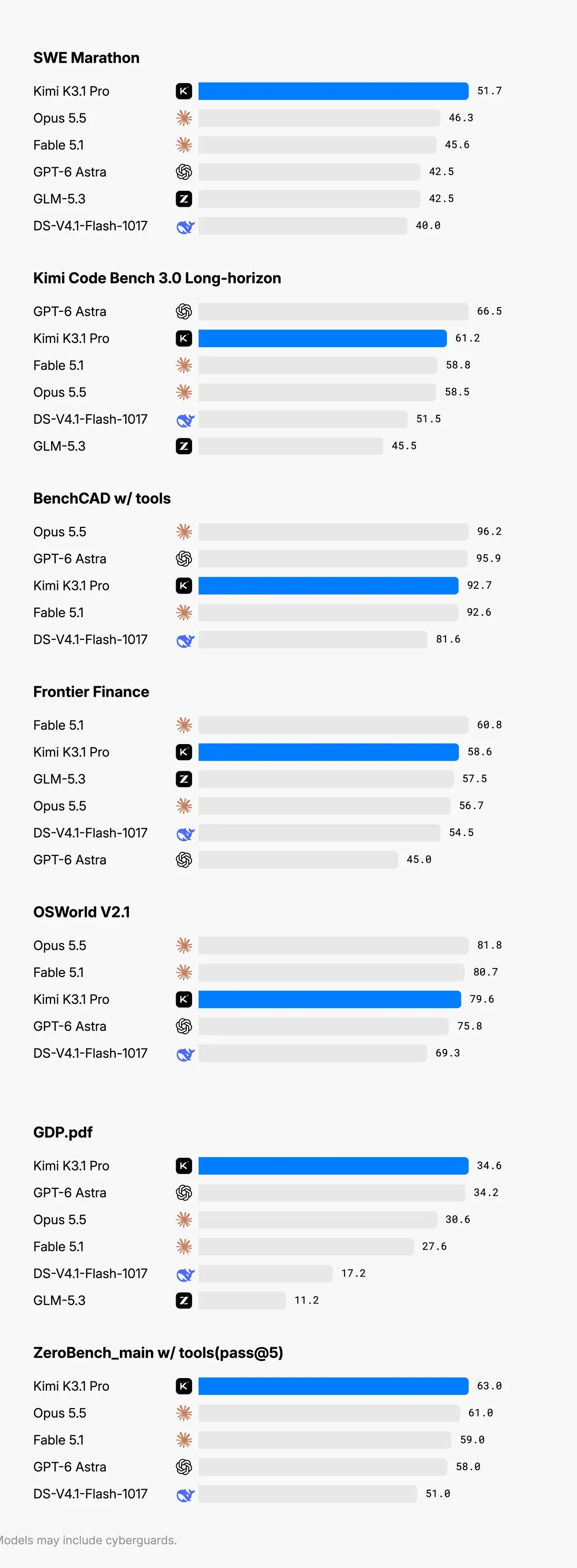
Across coding, agentic and knowledge benchmarks, K3.1 Pro matches or approaches the strongest proprietary models. On Terminal-Bench 4.0, which tests coding agents on resource-constrained terminal tasks with strict task-specific tests, K3.1 Pro scores 65.7% — ahead of GPT-6 Astra (58.2%) and just behind Claude Opus 5.5 (66.4%). On Kimi Code Bench 3.0 Long-horizon, the internal benchmark for multi-step execution, tool use and end-to-end problem solving across engineering domains, it scores 61.2% against K3’s 55.95%.
Coding
K3.1 Pro covers coding work at every scale, from a fix inside a real codebase to a whole project built from scratch. It also brings a more considered visual style to games and web experiences, and knows which external tools to reach for.
It works across game engines such as Unity, Unreal Engine and Godot, combining them with web search and 3D generation to produce complete experiences. Its front-end pages, interactive Three.js scenes and 3D assets show stronger composition, typography, animation and finish. The examples below were built end to end by K3.1 Pro:
Celestial Palace Battle Game in Unreal Engine Kimi K3.1 Pro built a mythical Eastern celestial palace in Unreal Engine 5.8, featuring a 36-bay colonnade with a radius of 1,750 meters and a colossal dragon procedurally modeled in Blender. The main character was created using MetaHuman. The scene contains 36 million source triangles and uses Nanite for rendering and Lumen for lighting. External assets used: Cloud Forge VDB Clouds, Poly Haven/ambientCG 8K materials, and NASA LRO/LOLA moon data.
3D Adventure Game in Godot Kimi K3.1 Pro built a stylized 3D action-adventure game using Godot 4.7.2. The project features five explorable regions with procedural terrain, roads, water, vegetation, and village layouts, alongside third-person combat, a two-phase Boss fight, gathering, a day–night cycle, and campfire fast travel. External assets used: Quaternius Stylized Nature MegaKit, Quaternius Medieval Village MegaKit, Kenney Survival Kit, Quaternius Ultimate Monsters, KayKit Character Pack, KayKit Character Animations 1.1, Quaternius Universal Animation Library, CDmir Goblin, rubberduck Vampire Bat, and the Fredoka, ZCOOL KuaiLe, and LXGW WenKai fonts.
3D Robotic Arm Landing Page Kimi K3.1 Pro built a browser-based 3D robotic-arm reveal with exploded views, transparent shells and cross-sections. It generates 2,317 parts and 268 dynamic wire routes in code, verified by 55 passing browser checks.
Large-scale reinforcement learning also strengthens long-horizon coding. In one internal test, K3.1 Pro built a human walking dynamics simulator, training and evaluation pipelines included, on top of human-atlas, an open-source anatomical model of the body with 296 skeletal components (cartilage included) and 402 muscles. Across 167 missions and 420 independent reviews it analysed results, diagnosed failures and re-tuned the walking controller until the simulated body went from collapsing within seconds to walking 11.2 seconds on alternating strides. When reward shaping failed to fix the arms, it ran open-loop probes of the simulator’s dynamics, traced and corrected 36 errors in the shoulder-muscle moment-arm calculations, then retrained the controller.
K3.1 Pro’s musculoskeletal walking simulator, from falling to a natural gait 296 skeletal components and 402 muscles, driven by a controller the model retrained itself.
3D modeling and design
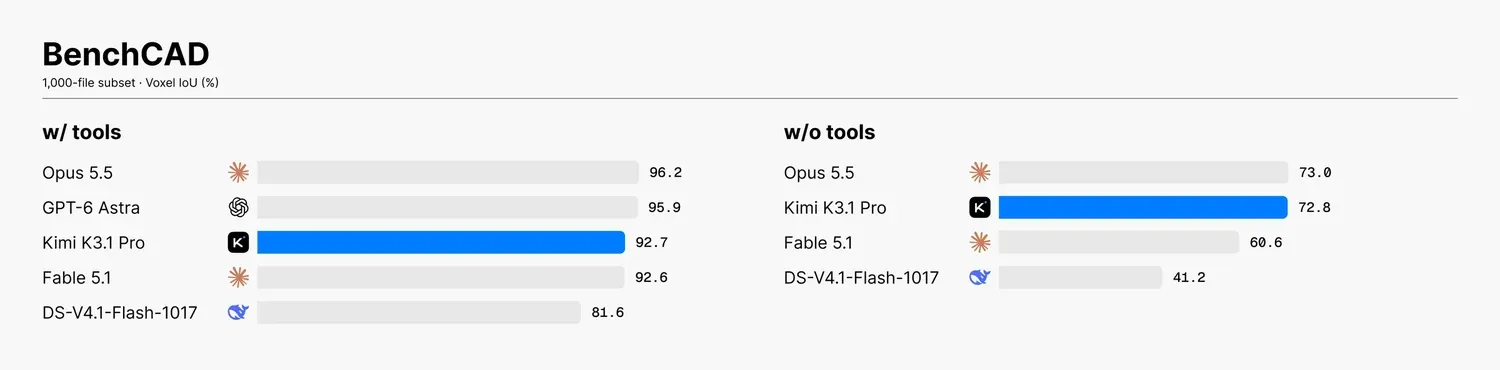
K3.1 Pro is strong at 3D creation and spatial reasoning. On BenchCAD, which tests 3D reconstruction from multi-view renderings through CAD code generation, it scores 92.7% with tools — close to Claude Opus 5.5 (96.2%) and GPT-6 Astra (95.9%) — and 72.8% without them. From a text brief, a sketch or a reference image it infers shape, proportions and spatial relationships and rebuilds them as usable 3D models. It also reads existing asset libraries and model collections better.
Parametric modeling is where it stands out: mechanical parts, architectural models, configurable products, custom furniture. Without MCP connectors it writes and runs scripts for tools such as Blender and CAD software, building and refining assets, editing individual components and adjusting geometry, materials and scene layout.
These cases were built end to end for brand films, games and interactive web experiences:
Airport Modeled in Blender Kimi K3.1 Pro built an airport's indoor rainforest valley in Blender, producing a 19.5-second, 1920×1080, 60 fps modeling showcase video. Tools used: Blender, Python, Geometry Nodes, Cycles, Pillow, NumPy, and FFmpeg. External assets used: "Kloofendal 48d Partly Cloudy (Pure Sky)" 4K HDRI from Poly Haven, by Greg Zaal and Jarod Guest, CC0 licensed, used for sky lighting and environment reflections.
Turbofan Model Built in FreeCAD Kimi K3.1 Pro used Python to build a detailed turbofan model in FreeCAD, covering the fan, reduction gearbox, compressors, combustor, turbines, and external piping across 2,100 solids. The project supports step-by-step assembly, an exploded internal view, and rotational animation demonstrating the fan, low-pressure spool, and high-pressure spool at 2,780, 8,590, and 12,400 RPM respectively.
3D-Printed Modular Lamp Built with Trimesh Using trimesh, Kimi K3.1 Pro created a five-part, 3D-printable table lamp inspired by Fujian tulou, reimagining its distinctive circular architecture as an intricate openwork lattice.

3D Make is now live on kimi.com and in the Kimi app: preview and edit 3D models online, download them ready for 3D printing, or export them as video or Live Photos to share.
Finance
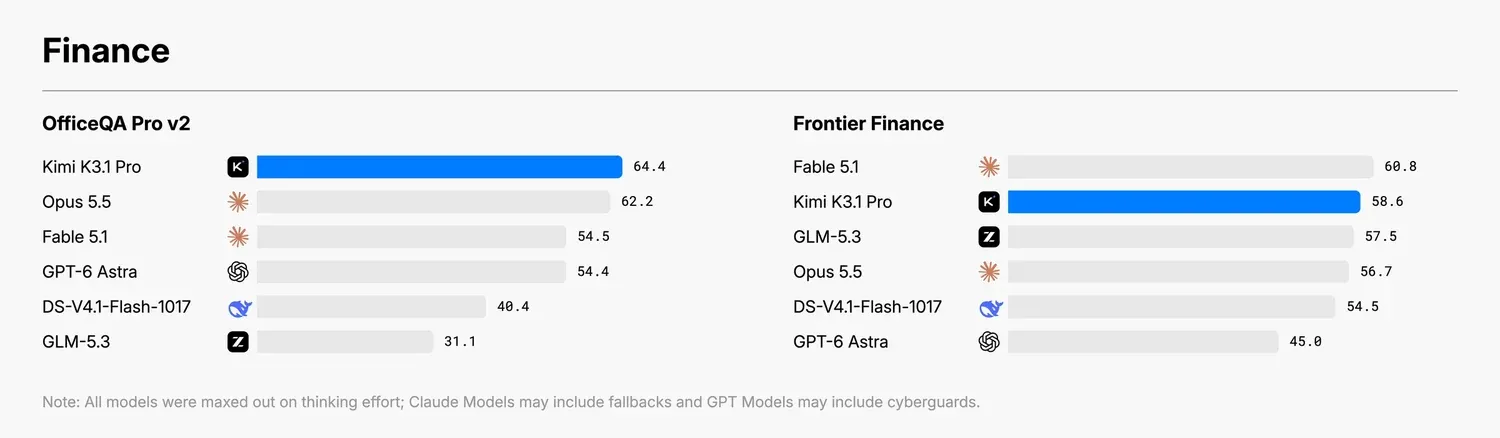
With stronger reasoning and tool use, K3.1 Pro delivers complete financial workflows end to end. On OfficeQA Pro v2, which tests complex fiscal analysis over real financial documents through retrieval, cross-document verification and multi-step numerical reasoning, it scores 64.4, the best result on the benchmark. It also improves on K3 on Frontier Finance, which measures support for the full investment workflow, from screening to profitability analysis.
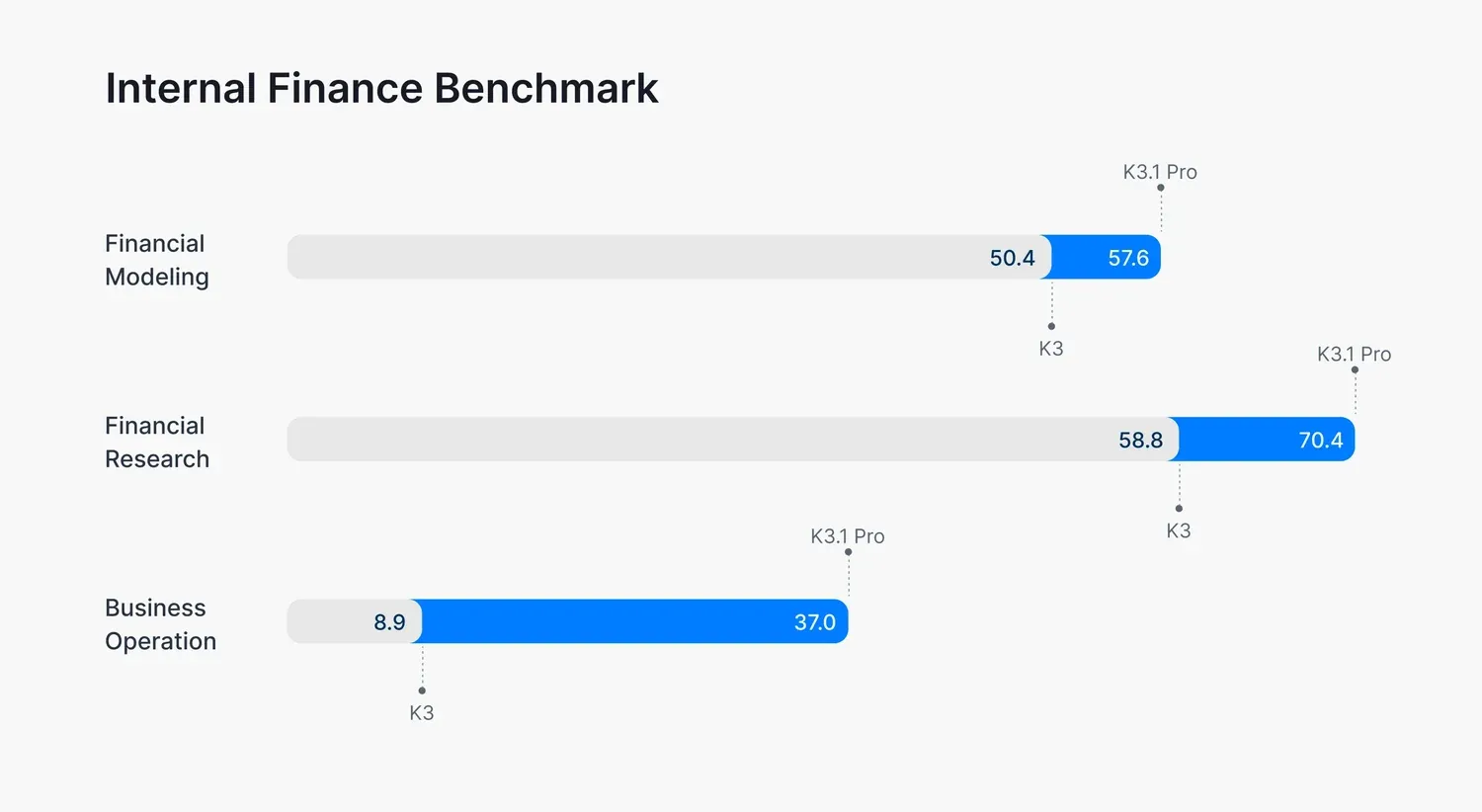
All three internal finance benchmarks move up as well:
- Financial Modeling — formula linkage, financial logic and final workbook quality in real modelling tasks: up 7.2 points on K3, from 50.4 to 57.6.
- Financial Research — auditable research under evidence and cutoff constraints: up 11.6 points, from 58.8 to 70.4.
- Business Operation — long-horizon management and decisions in a simulated business: 4.2× K3’s score, 37.0 against 8.9.
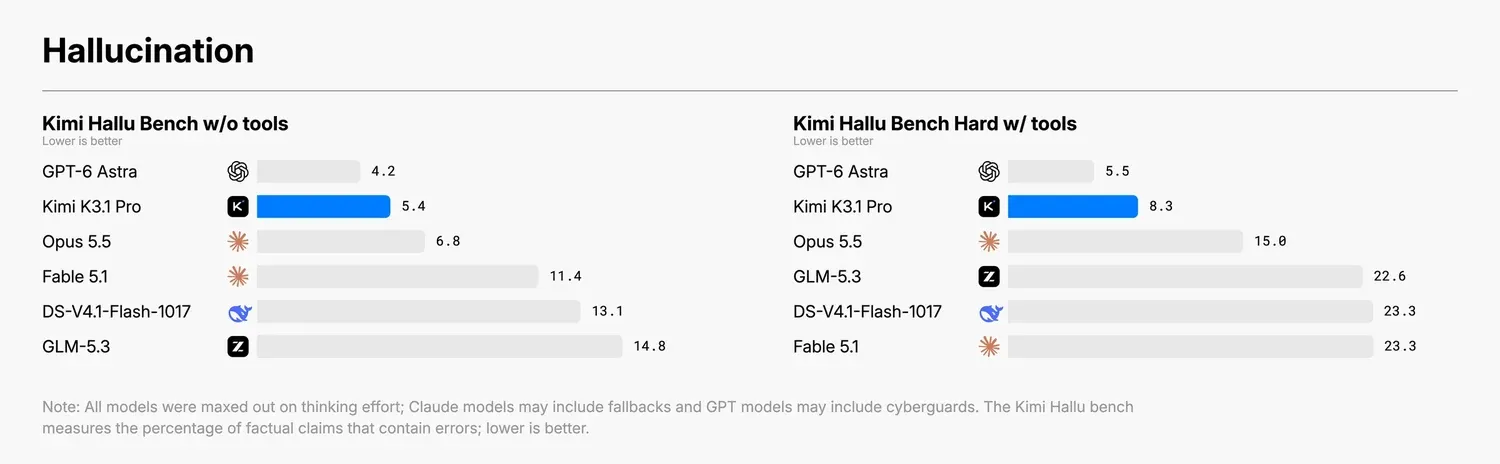
Financial analysis and investment research live on factual accuracy, so K3.1 Pro was tuned for exactly that on hard real-world tasks and prompts. On Kimi Hallu Bench Hard, the internal stress test, its claim-level error rate falls from 23.4% on K3 to 8.3%, and the share of answers carrying at least one factual error is 42.4% of the previous generation’s. (The benchmark is built to provoke mistakes; the rates are not daily-use error rates.)
The cases below show financial modeling, investment analysis and source-grounded research in practice:
NVDA financial model Kimi K3.1 Pro is capable to deliver professional NVDA financial models end to end, with full linked formulas and assumptions with solid reasonings. It builds models the way an analyst would: operating drivers can be adjusted across scenarios, with sensitivities showing the impact on valuations.
CATL investment-committee deck Kimi K3.1 Pro built an investment-committee deck on CATL (300750) — spotting the expectation gap vs consensus, reviewing the earnings print, and mapping the path forward. It writes the deck the way an analyst would: storyline first, the expectation gap vs consensus on the page, earnings reviewed against guidance, and mapping the catalyst forward.
Quantum-computing sector report Kimi K3.1 Pro built a quantum-computing sector report — arguing where consensus expectations miss, reviewing earnings against guidance, and analyzing the path after the print, every citation traceable to a source. It delivers institutional deep research the way an analyst would: expectation gap argued with evidence, earnings review and forward-path analysis included, every figure and citation tracing back to a primary source.
Cybersecurity
As K3.1 Pro grew more capable, Moonshot put a correspondingly larger share of effort into understanding where cyber capability comes from and how much of it can be controlled. It analysed and evaluated K3.1 Pro’s vulnerability research capability, then applied targeted controls during training — lowering misuse risk while keeping the model generally useful.
Identifying and removing cyber-related data. During development, vulnerability research performance improved steadily as post-training scaled. Tracing the trend showed cyber-related content embedded in the general mid-training corpus and cyber-related tasks sitting in the RL environment mix — a natural byproduct of training on broad data. Preliminary experiments on internal models showed that without data removal at either the mid-training or the RL stage, downstream cyber capability would rise substantially, which gave a concrete lever for control. For the open-weight release of K3.1 Pro, cyber-related data was identified and removed from both training stages, with the general-purpose coding tasks the model needs kept in place. Controls will keep being applied at every training stage; data identification and restriction is one of them.
Evaluation and results. After cleaning, K3.1 Pro was evaluated on xdev-bench-hard, an in-house benchmark of expert-curated, source-code-based vulnerability discovery and exploitation tasks, calibrated to differentiate at the current capability level. Most tasks reproduce recently disclosed vulnerabilities in the Linux kernel, Node.js, JavaScriptCore, Exim and VirGL with mitigations enabled; each task ships the vulnerable source, a short hint and the matching binary, and the agent has to produce an exploit that reaches arbitrary code execution in an isolated sandbox and retrieves a key string to pass automated verification. Scores are pass@3, with no strict timeout or output token cap.
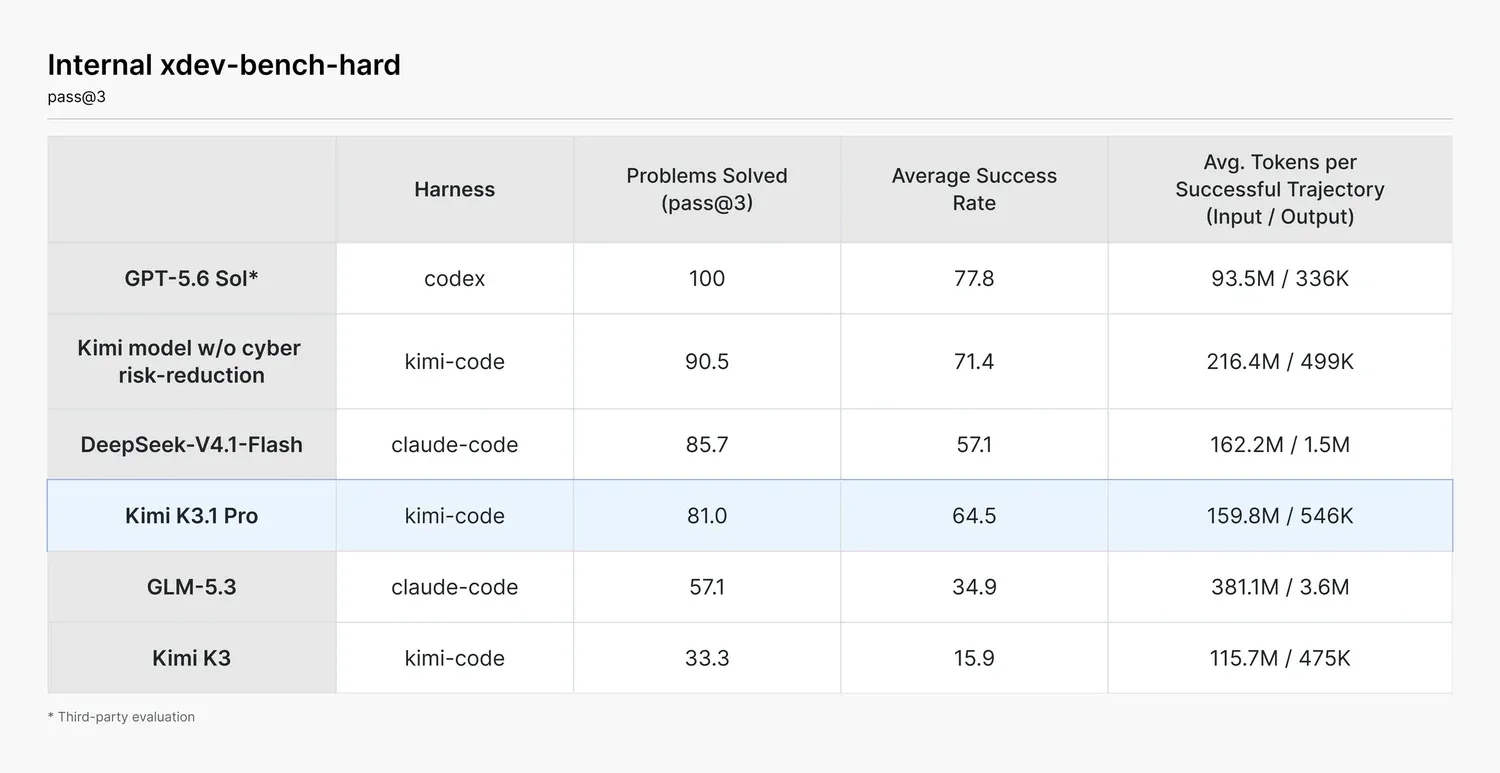
On xdev-bench-hard, the checkpoint with no cyber data removal at mid-training and no filtering of the RL mix solves 90.5% of problems at pass@3; the final K3.1 Pro reaches 81.0%. Removing the data measurably lowers vulnerability research capability, holding it clearly below what the same pipeline would otherwise produce. K3.1 Pro still improves sharply on its predecessor all the same, which says stronger general coding and long-horizon debugging generalise to these tasks even after the targeted removal. Its offensive security capability remains behind frontier closed models that have been publicly available for at least three months.
Open-weight principles. These evaluations framed the decision to release weights. First, Moonshot does not want to release open weights that push the absolute frontier of cyber capability: by design K3.1 Pro’s offensive capability sits below what the training pipeline would produce, and below the frontier closed models. Second, the plan is to raise cyber capability in open weights gradually. Open weights for K3.1 Pro should benefit the groups that need dual-use capability for defensive work: when capable models run on infrastructure their users control, more teams can review the code they maintain, including legacy systems that rarely get a dedicated security review. Letting this capability spread gradually, rather than concentrating it in a few closed systems, should leave all software safer.
Benchmarks
Unless stated otherwise, K3.1 Pro results use reasoning effort max, temperature 1.0 and top-p 0.95. Claude models may include fallbacks and GPT models may include cyberguards.
Pricing and availability
Full model weights are scheduled for release by Nov 4, 2026. Kimi Enterprise administrators can enable K3.1 Pro for their organisation; access is off by default at launch. On Kimi’s international API platform, the published rates are:
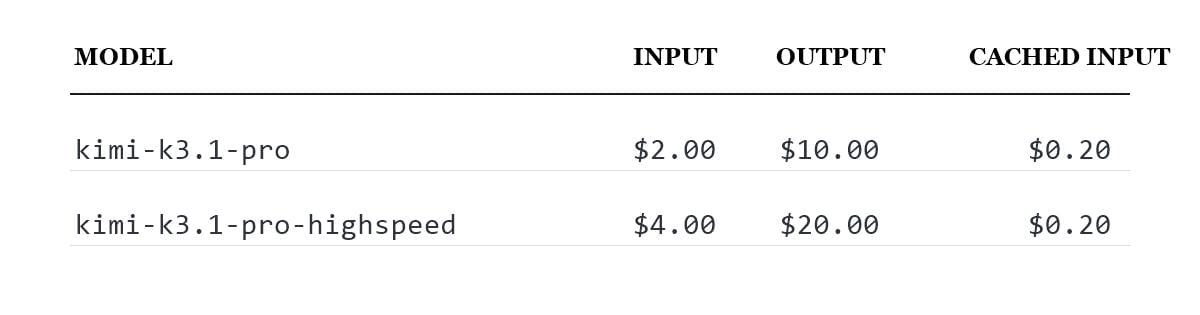
USD per million tokens. Highspeed runs at roughly 2–3× the output speed. Writing a prompt prefix into the cache bills at the input rate for a 5-minute TTL and 2× that for a 1-hour TTL.
This is DIT’s English edition of Kimi’s K3.1 Pro release post. Figures, benchmark scores and prices are as published by Moonshot on Oct 23, 2026.
[ $1 LAUNCH SPECIAL ] Kimi K3.1 Pro on DIT 15× the tokens. Just $1. ≈7.5M input or ≈1.5M output tokens.* Unlocks at launch. *Illustrative at $2/M in + $10/M out. |

Top AI models. Lower costs.
Access GPT, Claude, Gemini, and more through one OpenAI-compatible API—and save up to 70% on AI API costs. Create your DIT account, get your API key, and start building.