
Hi!
DIT Model Radar tracks new AI models daily — real models or confirmed codenames only, no tools, no hype.
Pika has released H3 Flex, a video and audio generator post-trained on MiniMax H3 that runs in six denoising steps instead of 50, drafts 15-second 768p clips with synchronized audio, and takes up to 12 mixed references. It is available now, and the generator adapters and inference code are published for local use under the model's license terms.
Pika’s H3 Flex is a post-trained MiniMax H3 tuned for iteration: fast passes, control over what changes between versions, and a high-resolution finish reserved for the take worth keeping.
Six steps instead of 50
Pika post-trained MiniMax H3 down to six denoising steps, then refined the faster model for quality and creative control. Pika reports a 15-second 768p clip with synchronized audio completing in as little as seven seconds of transformer (DiT) computation in a controlled benchmark.*
Pika reports #1 among open-weights models and #7 overall on DesignArena’s text-to-video leaderboard at the time of the release.*
A multi-shot narrative generated with Pika H3 Flex.
Twelve references, one generation
A prompt can describe an idea; a reference can show it. Flex accepts up to 12 reference files in a single generation, mixing images, video, and audio: a sketch, a character sheet, a product photo, a moodboard, a voice sample, or a clip of movement to carry over.
Each reference can be told what to contribute — the character from one image, the world from another, the movement from a video — with the result shaped around a chosen creative direction.
A knitted game world built from reference assets, with characters and environments carried across the sequence.

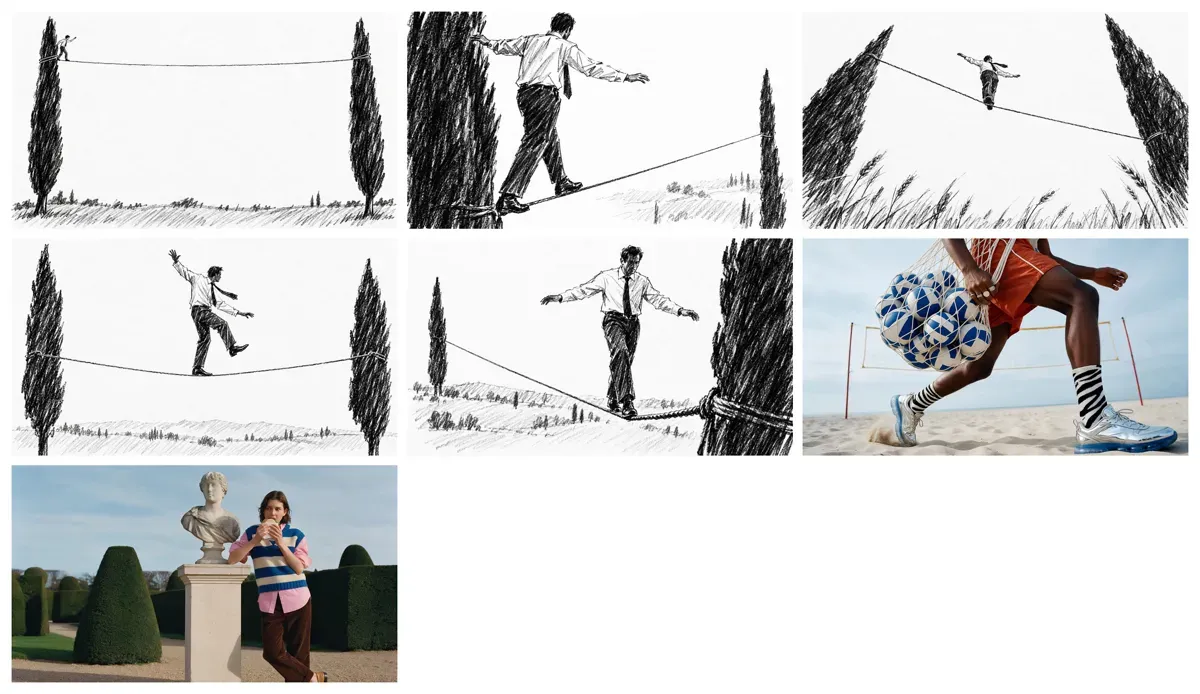
Shots can be sketched before they are generated: drawn keyframes combined with photographic references set the composition, camera, and look of a mixed-media film.
Charcoal tightrope: hand-drawn keyframes and photographic look references guide a live-action performance through a mixed-media world.
Product imagery holds a product’s appearance while a new setting, camera angle, or visual style is explored around it.
One product reference, reimagined as a multi-shot lip-gloss commercial.
Shot control: framing, movement, edits
Camera direction can be specific inside one clip: an overhead opening, a crane down to table height, a whip pan, and an orbit, with hard cuts, dialogue, and sound carried through a sequence.
A fast tracking shot across the farm, a dolly through the rows, and a close-up of the planting.
A reference video can drive choreography or a camera move while a new character and setting are built around it.
Silo waltz: choreography from a motion-reference video, performed by a new character in a concrete silo, with a new setting.
Silo waltz input: source choreography and timing. The generated version uses a new character and setting.
Reference-guided editing changes the parts of a shot that do not work: an outfit, a prop, or the world around the subject can be replaced while the performance and its timing are preserved.
Original footage: the performance and camera movement to preserve.
Edited version: a new setting and props, guided by the original footage.
Five audio stems
Flex generates video with synchronized stereo audio. Alongside it, Pika’s API returns five separate stems: dialogue, score, SFX, foley, and ambience.
Music can be turned down without turning down the conversation, effects worked on separately, and the mix rebuilt inside an edit.
Cube Haircut — generated video with synchronized audio.
480p and 768p native, up to 4K finish
Flex generates natively at 480p and 768p. Pika’s upsampler takes a chosen clip to 1080p, 2K, or 4K, preserving the generated content while adding detail, so the finishing pass is spent on the versions worth keeping.
768p draft.
4K finish, upscaled from the same generation.
Open weights, and what stays hosted
Pika is releasing Flex’s generator adapters and inference code under the model’s license terms, so developers and researchers can run it on their own hardware, adapt it, and build new tools around it.
The release covers text-to-video, first- and last-frame generation, and multimodal reference-to-video, with synchronized audio at 480p and 768p. The weights are published on Hugging Face, the code and setup instructions on GitHub, alongside Pika’s own write-up of how Flex was built.
The 1080p, 2K, and 4K upsampler, audio-stem separation, optional prompt enhancement, and the accelerated serving stack remain Pika-hosted features. Local performance depends on the hardware and the setup.
Pika’s pitch is a model that treats the first generation as a starting point: quick, controllable passes, and a finish for the take worth keeping, with the weights open underneath.
*Seven seconds measures transformer (DiT) computation for a 15-second 768p clip in a controlled benchmark, not total end-to-end API latency. Reference inputs, higher-resolution finishing, audio-stem separation, hardware, and service overhead affect completion time. Leaderboard position reflects the launch snapshot.
[ $1 LAUNCH SPECIAL ] Pika H3 Flex on DIT 15× the video. Just $1. ≈90 seconds of video.* Unlocks at launch. *Estimated at typical video pricing; launch price TBD. |

Top AI models. Lower costs.
Access GPT, Claude, Gemini, and more through one OpenAI-compatible API—and save up to 70% on AI API costs. Create your DIT account, get your API key, and start building.